Category: Home Security

  • Review: Reolink RLC-422 5MP PoE Dome IP Camera

    Review: Reolink RLC-422 5MP PoE Dome IP Camera

    Review - Reolink RLC-422 - Rear - VueVille

    It feels like it was just a few months ago that I reviewed my first 4MP camera, a Hikvision mini-dome.

    Today I am going to take a closer look at the 5 Megapixel Reolink RLC-422 dome camera with 4x optical zoom, kindly provided by Reolink for this review.

    [wpsm_titlebox title=”Contents” style=”main”][contents h2][/wpsm_titlebox]

    A quick note: As an Amazon Associate I earn from qualifying purchases. This post contains affiliate link(s). An affiliate link means I may earn advertising or referral fees if you make a purchase through my link, at no extra cost to you.

    What’s in the box

    Review - Reolink RLC-422 - Box - VueVille

    The RLC-422 comes in an attractive package that showcases the Reolink mobile app on one side, and lists the camera features on another side.

    Review - Reolink RLC-422 - Box Rear - VueVille

    On opening the box I found the RLC-422 camera to be well-protected with foam padding along with some accessories. Not surprising as every Reolink camera I have unbowed has been well packed.
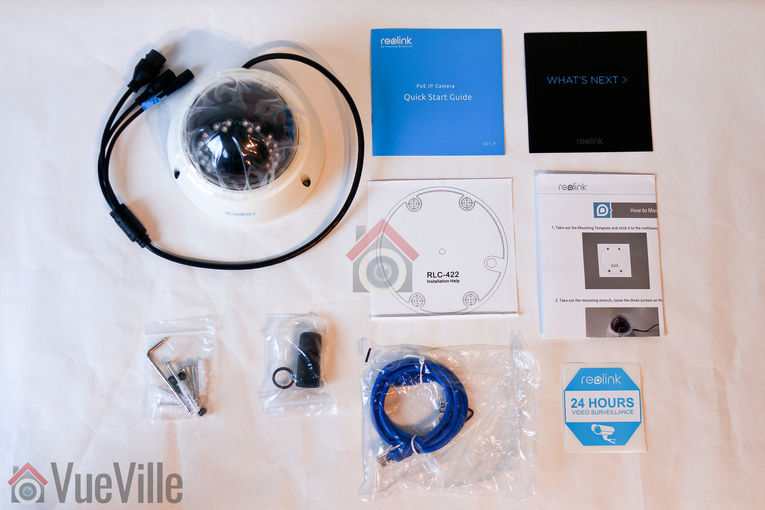
    Review - Reolink RLC-422 - Box contents - VueVille

    Box contents:

    • RLC-422 Zoom IP camera
    • Waterproof sleeve for Ethernet cable
    • 1 metre blue network cable
    • Screws, rawl plugs and an Allen key
    • Software CD
    • Quick start guide
    • What’s next guide
    • Installation guide with photos
    • Surveillance sign
    • Mounting hole template

    Specifications

    [table id=44 responsive=”scroll” /]

    Design

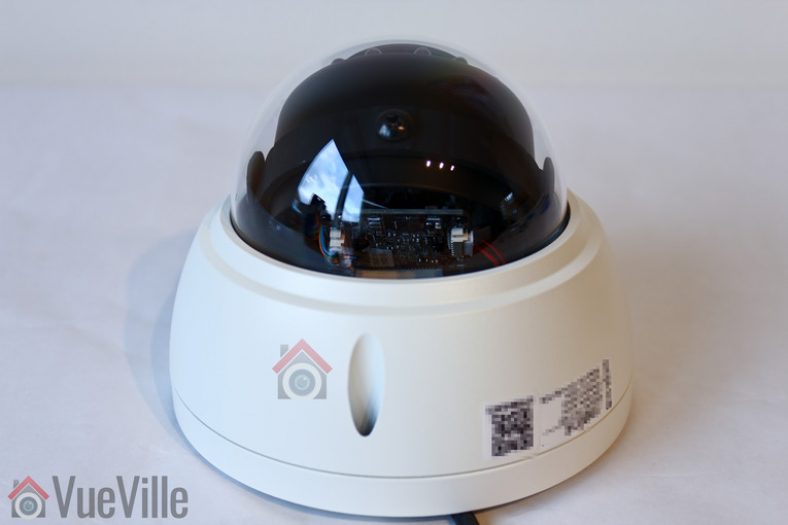
    The RLC-422 has a traditional dome type design. This is a camera with a motorized lens though, so it is slightly larger than a fixed lens dome camera.

    The base of the camera is made of steel and is painted white. The quality of the finish is very good and it feels like a camera that is far more expensive that it really is. The dome is made of clear plastic – I prefer it to be darkened because then its more difficult to figure out where exactly the lens is pointed.

    Review - Reolink RLC-422 - Front - VueVille

    On one side there is a sticker with the QR code for the mobile app setup and login details. I recommend removing this sticker before installing the camera outdoors.

    Review - Reolink RLC-422 - Rear - VueVille

    Unscrew three screws to open the camera and separate the dome from the base. The screws hold themselves in position in their holes when loose, and this is exactly what you want when you are trying to install the camera overhead. No screws falling out when you least want it.
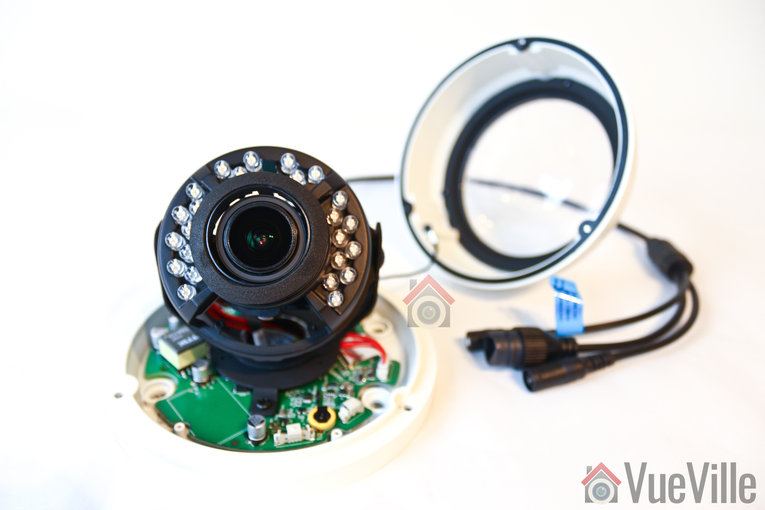
    Review - Reolink RLC-422 - Inside - VueVille

    The lens assembly can be adjusted in two axes – the base of the lens rotates and the lens itself pivots around the arms. There are two screws that you need to loosen to allow this motion. One thing I always like to check is whether any of the 24 IR LEDs are blocked. As you can see in the photo below, we have no such issue with the RLC-422. You can also see the cord that connects the dome cover to the camera base, again terribly useful when you are trying to install the base to a ceiling.
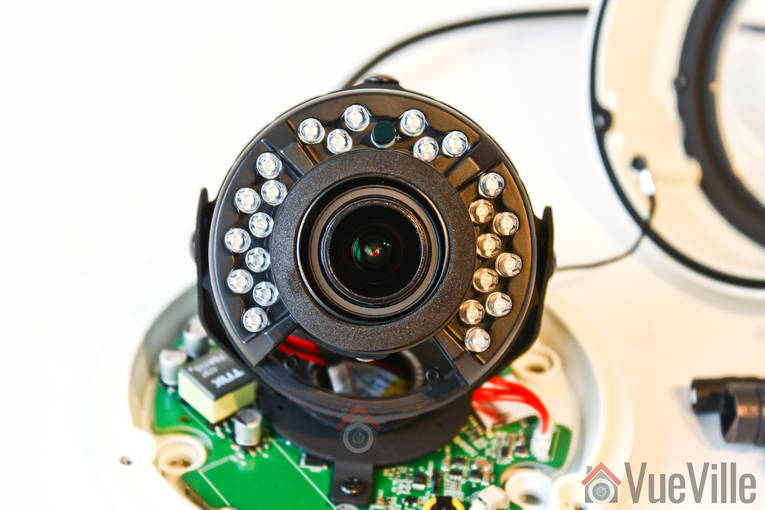
    Review - Reolink RLC-422 - Inside 2 - VueVille

    The rear of the lens assembly can be seen below.
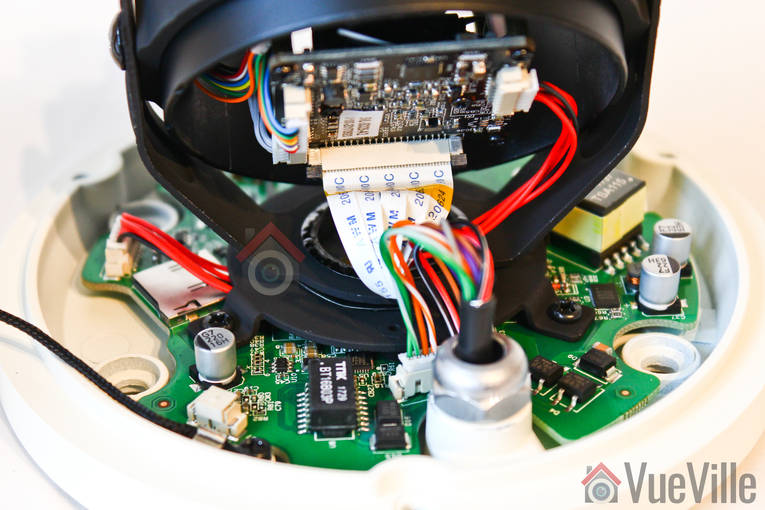
    Review - Reolink RLC-422 - Inside 3 - VueVille

    All the cabling comes out of the holder arm and can conveniently go into a junction box or down the wall through a cut-away provided for this purpose. The cabling consists of a pigtail with the following connectors:

    • 12V power input jack
    • RJ-45 ethernet port
    • A reset push button

    Just like the Reolink RLC-423 PTZ I reviewed, the reset button of the RLC-422 is not on the main body of the camera. Apart from eliminating an ingress point, it means nobody can reset the camera unless they get to the hidden reset button which is probably inside the wall or the soffit! This is much better than many other cameras such as Hikvision’s which have the reset button externally on the camera body itself.

    Installation

    I am not a huge fan of installing dome cameras, because they are generally a lot more work to install than a bullet camera. But as we saw earlier, Reolink has made it as painless as they can with the self-holding screws and the dome being linked to the camera base.

    Hardware setup

    The RLC-422 supports Power over Ethernet (PoE) which is my recommended way of powering IP cameras – using just a single Ethernet cable, you can send both data and power to the camera using either a PoE switch or a PoE injector.

    You can adjust the lens around the perpendicular axis of the camera and you can rotate the lens around its own perpendicular axis by loosening the screws.
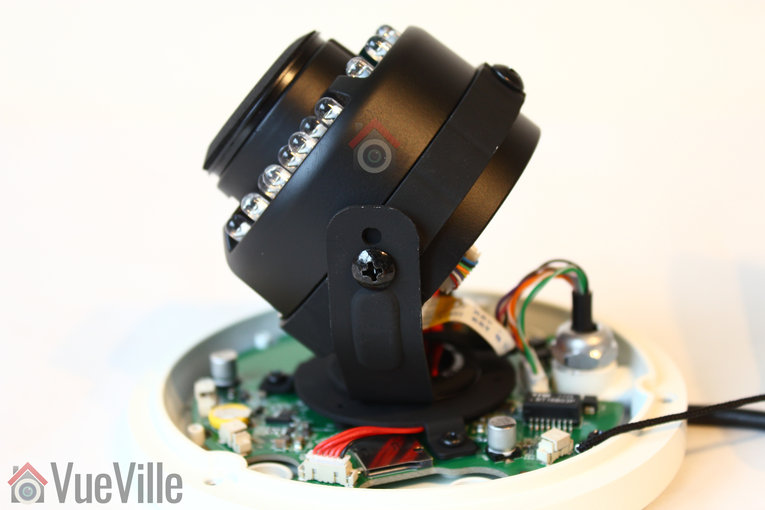
    Review - Reolink RLC-422 - Inside 5 - VueVille

    A typical fixed lens camera needs around 7W power, but the motorised lens of the RLC-422 means that it needs a little more power, a maximum of 10W to be exact. This is still within the 802.3af spec, so my TP-Link PoE switch had no trouble powering up the camera over PoE.

    I added a Sandisk 64GB SD card so that I can record motion detection clips on-board the camera itself.

    Review - Reolink RLC-422 - SD Card - VueVille

    If you want to use the included waterproofing connector, you will have to remove the RJ-45 plug on the Ethernet cable and re-crimp it once it has been passed through the waterproofing connector.

    Software setup

    Most manufacturers ship their cameras with static IPs by default – for example Hikvision and Dahua. In most cases the camera will not have the same network settings (like sub-domain) as your network. This means that you cannot access the camera unless you change the camera network settings to that of your network. You are expected to do this using the manufacturer’s camera finder tool. While this static IP method has security benefits, most home users would find it much easier if the camera manufacturer used DHCP as default. Then the camera would automatically be configured to use your network settings and be ready to use.

    As with all the Reolink cameras I have tested, this is exactly the case with the RLC-422:  DHCP is enabled by default. When you are setting up the RLC-422 using DHCP, you won’t know what its IP address is and so will have no way of directly accessing the camera. If you have IP reservation set up on your router, yes then you may know. But let’s assume you don’t know the IP address. You just need to find the IP address of the camera and there are quite a few ways you can do this:

    1. Use the Reolink mobile app
    2. Use the Reolink desktop client software
    3. Use any camera monitoring software such as BlueIris
    4. Use a mobile security camera app such as tinyCam Monitor Pro
    5. Scan your network using a network scanner app

    The helpful setup guide suggests the first two methods – Access the camera by smartphone and access the camera by computer.

    I have tried option 1 with another Reolink before so I went with option 2 this time – setup through a computer. These are the steps I followed:

    Step 1: I downloaded the Reolink Desktop Client app from the URL as the manual suggested: https://reolink.com/software-and-manual/

    Step 2: Installed Reolink Desktop Client v7.2.2.12 updated Oct 8, 2017, and ran it. Windows Defender identified it as a new app and asked me if I want to allow it Internet and LAN access. I allowed it to proceed.

    Step 3: The app automatically identified the camera and logged in successfully, and presented me with the Live View screen.

    Step 4: As I mentioned earlier, the camera has DHCP enabled by default but I like to assign my cameras static IP addresses. The main reason is that its easier to set up and access the camera form other devices wihtout having to check each time what the IP address is. Clicking on the setup gear icon and clicking through to Netowrk>General allowed me to change it. This caused the Reolik app to add another camera to the list, with my new static ip address. It also then started complaining that it could not find the original camera with DHCP IP address. This was a bit tiresome so I disabled the ‘Add Camera Automatically’ option under app settings. No reboot was needed which is great.

    Step 5: I then tried to access the camera from the new static IP address through Chrome. I logged in with the default login details. However since the camera admin site uses Flash and Chrome disables it by default, I just had to click on the “Get Adobe Flash player” button in the live view section and enable it in Chrome.

    Step 6: I then changed the password for the admin account. I also created a new user and tried to delete the admin account for safety but like most IP cameras, the RLC-422 doesn’t support this feature.

    Once you have the IP address, you can simply pop that into Chrome or Firefox to directly access the camera settings. You could also use the desktop client app to change camera settings if you don’t want to use the web-based admin panel.

    You should change the password of the camera as soon as you can, especially worth noting as the camera doesn’t require you to nor remind you to do it.

    Software features

    I have a number of ways of accessing my camera live feeds – typically I use the tinyCam Monitor Pro app on my Android phones, sometimes I flick my TV over to the QNAP Surveillance station channel (thanks to the TS-253A’s HDMI output). But when I want to tweak camera settings, I prefer using the web admin page – I can watch the live view stream, adjust the zoom and change camera settings.

    So entering the camera’s IP address into any browser that supports the Adobe Flash player will let you login to the camera. As I always say, an HTML5 interface would have been better for wider device compatibility but its far better than the NPAPI plugin that Hikvision still insists on using. You can choose the stream you want to see at the login screen, Channel 1 is called Clear and is the 5 Megapixel stream (unless you have changed the camera settings). The other options are Balanced and Fluent. These can also be selected once you are logged in.

    Review - Reolink RLC-422 - Web Admin Live View - VueVille

    Reolink calls the landing page the Preview page, but I like to call it the Live View page, which is more logical. On the left hand side you have the live view stream, and at the bottom clicking the play button lets you select between the video quality by switching between the Clear, Balanced and Fluent streams.

    On the right hand side, an accordion type content holder has three sections – Optical Zoom, Basic settings and Advanced settings. The basic and advanced settings sections are like a quick access area that duplicates the settings on the actual configuration page – accessed by clicking on the gear button at the top right.

    The Optical Zoom section adjusts to the abilities of the camera. In the RLC-423 it let you zoom, and adjust the focus manually. With the RLC-422, you have only the zoom function. You can also adjust the focus manually, but since it has auto-focus I recommend not changing it.

    The Basic Settings section includes OSD settings, video stream encoding and image settings. The OSD page is pretty standard and lets you choose whether and where to show the OSD information such as day, date and time.
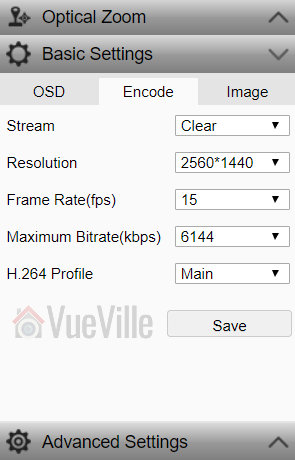
    Review - Reolink RLC-422 - Web Admin Basic Settings - VueVille

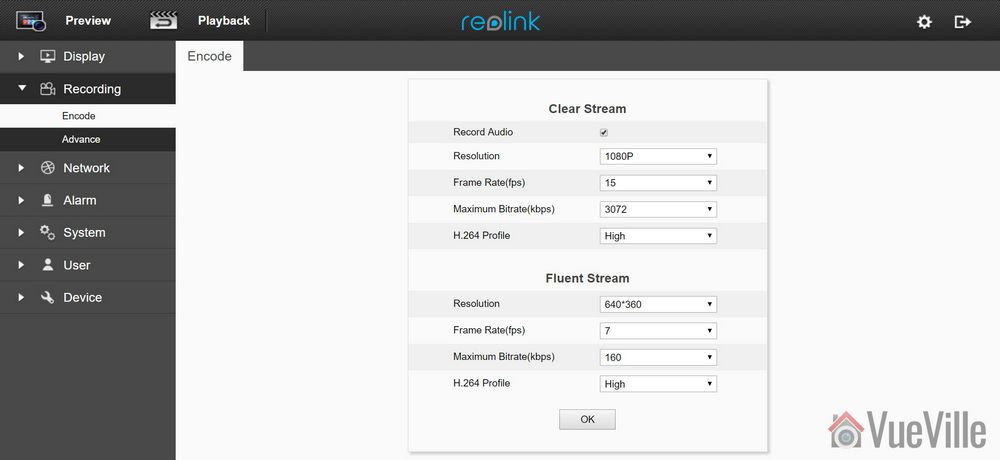
    The Basic Settings is where you can set the video resolution, bitrate and frames per second of each of the Primary “Clear” stream (5MP default) and the Fluent stream (640×360 default). Interestingly, the ‘Balanced’ stream is missing in the stream selection dropdown.

    The Image section lets you adjust the usual image settings such as brightness, contrast, saturation, sharpness and also mirroring and image rotation.

    Review - Reolink RLC-422 - Web Admin Adv Settings - VueVille

    The advanced settings tab is where you will find the rest of the video settings and the ones I was most interested in – exposure, backlight and noise reduction. Setting the Exposure to ‘Low Noise’ lets you control just the range of gain, ‘Anti-smearing’ lets you control only the range of shutter speeds and manual lets you select both the gain and shutter speed ranges. The range selection method is novel – it means the camera will automatically choose the optimum settings from the range you specify. I didn’t see an option to change the i-frame interval. This is a bit strange as it is a setting that I would have expected to find. Why is it important? The i-frame setting specifies how often the entire frame is captured and not just what has changed from the previous i-frame. So being able to control it is important for getting the right balance between network bandwidth utilisation and a high quality non-blurry video.

    Now the full camera settings configuration page is accessed by clicking the gear icon at the top right of the Live View page. This lets you access video resolution, network, motion detection, email and push notifications, user control, and system maintenance settings.

    Review - Reolink RLC-422 - Web Admin Encode - VueVille

    Click to enlarge

    While the camera support motion detection alerts, these are of the basic variety. There is no advanced motion detection such as line crossing, or intrusion detection on offer here. One of the best ways to reduce false alerts is by using these advanced motion detection methods, so bear this in mind if you are planning to use this camera not for 24/7 recording but motion triggered recording. I would use it only for 24/7 recording or to capture images and videos based on commands from my DIY home automation system.

    Review - Reolink RLC-422 - Web Admin Email - VueVille

    Click to enlarge

    Review - Reolink RLC-422 - Web Admin Push - VueVille

    Click to enlarge

    There is a built-in NVR feature, so the camera can record motion detection clips to the on-board SD card, and even 24/7 a network/NAS drive. The timeline feature is very handy and works well.

    Review - Reolink RLC-422 - Web Admin Playback - VueVille

    Click to enlarge

    Performance

    I tested the camera at its default settings of 5MP resolution and 20fps. Here are the properties of the video files it created:

    [wpsm_codebox style=”1″]Daytime Video: MPEG4 Video (H264) 3072×1728 20fps 6253kbps [V: English [eng] (h264 high L5.1, yuv420p, 3072×1728, 6253 kb/s)][/wpsm_codebox]

    [wpsm_codebox style=”1″]Night-time Video: MPEG4 Video (H264) 3072×1728 23.75fps 6105kbps [V: English [eng] (h264 high L5.1, yuv420p, 3072×1728, 6105 kb/s)][/wpsm_codebox]

    I also added the RLC-422 to my favourite mobile CCTV app, tinyCAM monitor Pro and confirmed that I can view the camera streams there also.

    However to optimise recording storage, I suggest recording at 4MP resolution and to lower the frame rate to 10fps:

    [wpsm_titlebox title=”Recommended Video Stream Settings” style=”3″]
    Primary Stream: 4MP (2560×1440), constant 6144 Kbps @ 10 fps.
    Secondary stream: 640×360, 512 Kbps @ 6 fps.
    [/wpsm_titlebox]

    Optical Zoom Function

    The optical zoom function is the headline feature of the RLC-422. I found the zoom speed to be on par with that of the Reolink RLC-423 PTZ. The autofocus is a bit sluggish just like the RLC-423 but at such an affordable price, I shouldn’t complain.

    Daytime video quality

    The RLC-422 is a 5 megapixel with a 1/3″ sensor. In the daytime video is crisp and appeared to be sharper than my 4 Megapixel Hikvision DS-2CD2542FWS-IWS as well as the 4 Megapixel Reolink RLC-423 PTZ.

    If the camera has one weakness, its the speed of the autofocus. While the accuracy of the autofocus is pretty good, it does take a few seconds to autofocus after zooming in or out.

    Here’s a sample video of a recording during the daytime:

    [wpsm_video]https://www.youtube.com/embed/KplV0thvNqs[/wpsm_video]

    Night-time video quality

    The real test of an IP camera is when the sun’s gone down and the lights are off. The RLC-422 uses 24 conventional IR LEDs arranged in a ring around the lens. I did not see any evidence of internal reflections or ghosting, common issues with lesser dome cameras.

    Note that the RLC-422 doesn’t have true WDR, it employes digital WDR.

    So how did it perform? The video quality is great with just a hint of noise. Check out the sample video below shot at default image settings (backlight off and 3D Noise Redcution on):

    [wpsm_video]https://www.youtube.com/embed/pfG8Vrfwr8M[/wpsm_video]

    Mobile app

    The Reolink mobile app is one of the best original manufacturer apps I have seen. Hands down beats Hikvision’s rather poor efforts and runs circles around other brands’ apps. I was able to quickly add the RLC-422 to the Reolink app on my phone, adjust the zoom level, and access the recorded clips stored on the on-board SD card.

    Verdict

    The RLC-422 is a very affordable 5MP dome camera capable of stand-alone operation due to the built-in NVR feature. However this is limited by the lack of advanced motion detection features. While the 5MP resolution is class-leading for affordable budget IP cameras, it is designed to a price – the lack of advanced motion detection methods, a microphone, audio and alarm connections and the slow auto-focus give away its budget nature. But for those who need a 24/7 recording dome camera with optical zoom, the ONVIF and RTSP support makes the camera very easy to integrate with an existing home CCTV or security system.

    [review]

    Where to buy

    [easyazon_link identifier=”B01B4BKJHW” locale=”US” tag=”vueville.com-eaz-20″]Check Price on your local Amazon site[/easyazon_link]

    (* = affiliate link / image source: Amazon Associates Program)
  • Best Surveillance Hard Drives for NAS NVR and Dedicated NVR – 2024 Recommendations

    Best Surveillance Hard Drives for NAS NVR and Dedicated NVR – 2024 Recommendations

    Hard drives are not really the first thing that comes to our minds when we are thinking about our CCTV setup. That honour goes to the camera right? Whether you plan to record just motion detection clips or 24/7 round the clock, the safety of your recordings comes down to one thing: the hard drives you choose for your NVR (Network Video Recorder) or DIY NAS NVR (Network Attached Storage NVR).

    In fact, I would say that the hard drive is the weakest link in your CCTV setup. Why? Because it is the only mechanical device in the whole system. Since hard drives do not last forever and will fail at some point, it is very important to choose the best hard drive for your NVR or NAS.

    BEST NAS NVR DRIVE
    Seagate IronWolf & IronWolf Pro
    Seagate IronWolf 8Tb NAS Internal Hard Drive HDD – 3.5 Inch SATA 6GB/S 7200 RPM 256MB Cache for Raid Network Attached Storage (ST8000VN0022),Silver
    ×
    Product prices and availability are accurate as of the date/time indicated and are subject to change. Any price and availability information displayed on https://www.amazon.com/ at the time of purchase will apply to the purchase of this product.
    5400-7200 rpm
    Uses only CMR tech
    180-550 TB/year rating
    RUNNER-UP NAS NVR DRIVE
    WD Red Plus & Pro NAS Hard Drive
    Western Digital 4TB WD Red Plus NAS Internal Hard Drive HDD - 5400 RPM, SATA 6 Gb/s, CMR, 256 MB Cache, 3.5" -WD40EFPX
    ×
    Product prices and availability are accurate as of the date/time indicated and are subject to change. Any price and availability information displayed on https://www.amazon.com/ at the time of purchase will apply to the purchase of this product.
    5400-7200 rpm
    Uses only CMR tech
    180-300 TB/year rating
    BEST DEDICATED NVR DRIVE
    WD Purple and Purple Pro
    Western Digital 8TB WD Purple Surveillance Internal Hard Drive HDD - SATA 6 Gb/s, 256 MB Cache, 3.5" - WD82PURZ
    ×
    Product prices and availability are accurate as of the date/time indicated and are subject to change. Any price and availability information displayed on https://www.amazon.com/ at the time of purchase will apply to the purchase of this product.
    5400-7200 rpm
    Uses only CMR tech
    180-550 TB/year rating

    A quick note: As an Amazon Associate I earn from qualifying purchases. This post contains affiliate link(s). An affiliate link means I may earn advertising or referral fees if you make a purchase through my link, at no extra cost to you.

    (* = affiliate link / image source: Amazon Associates Program)


    [wpsm_titlebox title=”Contents” style=”main”][contents h2 h3][/wpsm_titlebox]

    Best Hard Drives for Surveillance NVR – 2024 Recommendations: Summary

    [table id=72 responsive=scroll /]

    (* = affiliate link / image source: Amazon Associates Program)

    I use my QNAP TS-253A NAS as my NVR, you can see my full setup here. The TS-253A is a few years old now, so do look at my latest NAS choices.

    If you already have a NAS and don’t need more than a couple of IP cameras, you may not even need a dedicated NVR. Your NAS can probably do double duty as your NVR. There are several benefits in doing this, namely that you automatically get the benefits of a redundant backup thanks to the RAID-1 option.

    RAID-1 means that as the NAS records the IP camera stream, it automatically copies it to the second hard drive in the NAS. This setup of hard drives is called RAID (Redundant Array of Independent Disks) and is also the key reason I recommend using a NAS as your NVR, with frequent (weekly for me) USB backups to an external drive. Some NVRs can do RAID but they tend to be a lot more expensive, but for a NAS this is its main feature – redundant storage.

    I will be considering only the traditional mechanical spinning drives because large capacity SSDs are still too expensive for home users and are less durable. I have split this round-up into two main sections: hard drives for NAS NVR usage and for dedicated surveillance systems.

    Players in the HDD market

    Western Digital, Seagate and Toshiba are the market leaders. It’s worth noting that Western Digital now owns HGST (Hitachi). Also interesting is the fact that WD and Toshiba are partners.

    CMR vs. SMR controversy

    As drive capacities increased, disk manufacturers have found creative ways to cram more data into the same physical platters. Traditionally hard drives used a technology called Conventional Magnetic Recording (CMR) for arranging data tracks in the disk platter. One of these newer technologies is called Shingled Magnetic Recording (SMR).

    SMR drives are cheaper to manufacture but are slower to write to and read from. So these drives use free space in the drive as a cache and may even have additional cache memory to offset the slower performance. However, with heavy read/write operations the cache will fill up and the read/write speed drops a lot.

    This may be fine for a backup drive, but not for NAS environments where raid rebuilding will result in unacceptable delays.

    Traditionally, all NAS drives from WD used CMR disks. But controversy erupted when WD was recently caught shipping NAS drives that use SMR, without disclosing it.

    See this test that shows a CMR based NAS rebuild (resilver) takes 17 hours but the same drive based on SMR takes 9 days!

    Since SMR drives are clearly inferior for NAS environments, the least that WD could do was disclose this change and mention it in their datasheets. But they didn’t which for me is a huge error in judgment from WD’s side.

    Thankfully all the WD drives I recommended in my post were the older CMR based drives with model numbers ending in ‘EFRX’. For example: WD40EFRX. So if you purchased the ones that were listed here, you are fine.

    In the end, they fessed up but clearly I have lost trust in them and have taken this into account in my recommendations by making Seagate my first choice for smaller drives and WD only for larger drives >8TB where only CMR is used.

    Seagate maintains that they have never used and currently do not use SMR in their IronWolf and IronWolf Pro NAS drives.

    Toshiba has admitted they use SMR in their drives, and have also not been disclosing this.

    Hitachi has also been found to be using SMR in their drives.


    Best Hard Drives for NAS NVR – My 2024 Recommendations

    Let’s take a detailed look at the various NAS hard drives available. For the sake of comparison, I will assume you are looking at a 4TB hard drive. This is the most common HDD size sold so should be a good fit for most people. So all the specs mentioned in the features box is for a 4TB model from the product family being discussed.

    Best Overall NAS NVR Drive: Seagate IronWolf & IronWolf Pro

    Seagate IronWolf 8Tb NAS Internal Hard Drive HDD – 3.5 Inch SATA 6GB/S 7200 RPM 256MB Cache for Raid Network Attached Storage (ST8000VN0022),Silver
    ×
    Product prices and availability are accurate as of the date/time indicated and are subject to change. Any price and availability information displayed on https://www.amazon.com/ at the time of purchase will apply to the purchase of this product.

    Click image to view on Amazon

    • 5900 rpm
    • 256 MB cache
    • CMR technology only
    • Drive Design – Air
    • 600,000 load/unload cycles
    • 1 million hours MTBF
    • 8760 hours power on time
    • 180 TB/year workload rating
    • 4.8W power usage
    • Rotational vibration sensors >= 4TB
    • 3 years limited warranty

    (* = affiliate link / image source: Amazon Associates Program)

    I remember my first computer hard drive – a 1GB Seagate ATA drive. It was a pretty nippy drive too! Seagate is also the one big hard drive brand that does not belong to or has not partnered with Western Digital, in fact it is WD’s only real competitor. Another popular brand from yesteryear is Matrox, which Seagate acquired in 2006. Seagate’s Barracuda drives are one of the most popular hard drives over the last decade.

    A casual perusal of Seagate’s product lineup with its bold and colourful marketing reveals the Guardian series of hard drives. This is where Seagate’s NAS offering lives. It comes in two flavours like Western Digital’s, the Ironwolf to be used in NAS enclosures up to 8 bays, and the Ironwolf Pro for up to 16 bays.

    The Ironwolf drive runs at a constant 5900 rpm. But interestingly the 6TB and higher models rotate at 7200 rpm (faster then WD Red) and have 256MB cache (matched by the WD Red only at 10TB). All other specs are similar such as the MTBF, workload and load-unload cycle ratings.

    The great thing about Ironwolf and Ironwolf drives are that they all use the superior CMR recording technology , unlike WD that uses both CMR and SMR across its NAS range.

    Compared to the Ironwolf, the Ironwolf Pro models add even more cache memory, have RV sensors across the board, have a higher 300 TB/year workload, up the warranty to 5 years and offer their 2-year ‘Rescue’ data recovery service as standard.

    Seagate NAS firmware optimisations called AgileArray work together with Rotational Vibration (RV) sensors (4TB drives and above), something that WD drives curiously don’t have. The firmware performs error recovery control as expected in a NAS drive. IronWolf Health Management is available on compatible NAS systems such as Synology and Asustor to provide better drive health data.

    A few years ago, Seagate faced some criticism over the reliability of its drives from hard drive statistics data released by Backblaze, a cloud storage provider. But as the recent numbers show, Seagate has taken this feedback seriously and seem to have over-engineered the Ironwolf range to improve its public perception.

    Runner-up NAS NVR Drive: WD Red Plus & Red Pro NAS Hard Drive

    Western Digital 4TB WD Red Plus NAS Internal Hard Drive HDD - 5400 RPM, SATA 6 Gb/s, CMR, 256 MB Cache, 3.5" -WD40EFPX
    ×
    Product prices and availability are accurate as of the date/time indicated and are subject to change. Any price and availability information displayed on https://www.amazon.com/ at the time of purchase will apply to the purchase of this product.

    Click image to view on Amazon

    • 5400-7200 rpm (Intellipower)
    • 128MB cache
    • CMR technology used in WD Red Plus and Red Pro
    • WD Red uses SMR – avoid!
    • 600,000 load/unload cycles
    • 1 million hours MTBF
    • 180 TB/year rating
    • 4.5W power usage
    • Only Pro has Rotational Vibration sensors
    • 3 years limited warranty

    (* = affiliate link / image source: Amazon Associates Program)

    Western Digital is the most recognisable name in the hard rive market and has been in the storage industry since the 1980s. But did you know that they acquired HGST (Hitachi’s storage division) in 2011 and Sandisk in 2016? These acquisitions have made WD top dog in the HDD market. Also interesting is the fact that WD and Toshiba are partners. Yet WD, HGST and Toshiba have stated that they all compete with each other.

    The current product line is simple and easy to understand – named after various colours:

    • Blue for standard desktop & laptop drives
    • Black for high performance desktop & laptop drives
    • Red, Red Plus and Red Pro for NAS drives
    • Purple for surveillance drives
    • Gold for enterprise drives

    The original WD Red drives have been the most popular NAS drives in the market. But then the SMR controversy hit when WD quietly changed some Red drive models to SMR recording technology from the superior CMR tech. To address the criticism of the poor transparency of its marketing material, WD has now changed the WS red lineup totally.

    Inexplicably WD still sells the SMR drives but only under the WD Red moniker. The CMR drives from the old Red line have been moved to the newly created WD Red Plus line. While Red Pro remains unchanged and continues to have only CMR models in it.

    So to summarize:

    • WD Red: SMR
    • WD Red Plus: CMR
    • WD Pro: CMR

    So avoid the WD Red line and only consider Red Plus and Red Pro lines. I don’t understand why WD still pushes the inferior SMR drives as NAS drives, when they are clearly not good enough due to the atrocious NAS re-build (re-silvering) times and widely reported RAID errors.

    The Red and Red Plus drives are aimed at NAS enclosures of up to 8 bays, and the Red Pro for more than 10-16 bays.

    I have been using WD Red drives in my QNAP NAS for the past 5 years and have been very happy with the performance, reliability and quietness of these drives. Of course back then they were selling only CMR models. Personally I have found the WD RED drives to be extremely quiet in operation, which is an important feature as the NAS sits in once corner of my living room.

    The NAS optimisations on the software front are packaged into the special firmware WD calls NASware 3.0.

    An interesting feature that’s unique to WD is the Intellipower system which optimises the rotational speed, transfer speed and cache usage to optimise performance and power consumption. In practice, this means the rpm ranges between 5400 and 7200 rpm and results in a best-in-class power consumption of just 4.5W in operation (for the 4TB drive). In most cases, the performance of the Intellipower drive should be comparable to that of a conventional 7200rpm drive such as the Hitachi HGST Deskstar.

    The Red Plus & Red Pro drives also boast a high load/unload cycle rating of 600,000 similar to the Seagate Ironwolf & Ironwolf Pro. However the smaller WD Red Plus drives have only 128 MB cache whereas the Ironwolf has 256 MB for the same sizes. Other ratings are inline with the industry at 1 million hours MTBF, 180 TB/year workload rating, and 3 years limited warranty.

    The Red Pro drives are a step above with higher internal transfer rates, 512MB cache, 300 TB/year workload and 5 years warranty. This is broadly similar to Seagate’s Ironwolf strategy. I don’t see the need for home NAS NVRs to get the WD Red Pro drives unless you need the higher workload capacity.

    How about some practical numbers from my own NAS? I have been running my 2-bay QNAP NAS 24/7 with 3TB drives in RAID-1 for 5 years now. The original pair of drives I bought are both dead now – the first drive after 1.5 years of service and the second after nearly 5 years of 24/7 service.

    Alternative NAS NVR Drive: Toshiba N300 & N300 Pro

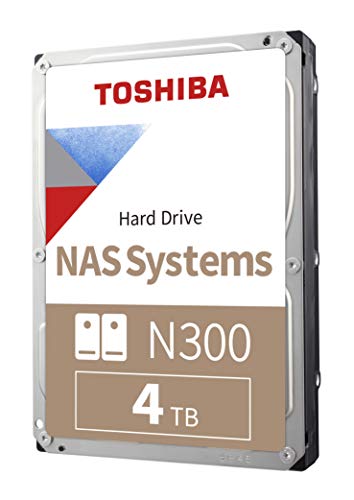
    Toshiba N300 4TB NAS 3.5-Inch Internal Hard Drive - CMR SATA 6 GB/s 7200 RPM 256 MB Cache - HDWG440XZSTA
    ×
    Product prices and availability are accurate as of the date/time indicated and are subject to change. Any price and availability information displayed on https://www.amazon.com/ at the time of purchase will apply to the purchase of this product.

    Click image to view on Amazon

    • 7200 rpm
    • 128 MB cache
    • Only CMR used
    • 300,000 load/unload cycles
    • 1 million hours MTBF
    • 180 TB/year workload rating
    • 9.6W power usage
    • Only N300 Pro has Rotational vibration sensors
    • 3 years limited warranty

    (* = affiliate link / image source: Amazon Associates Program)

    Toshiba NAS drives are not hugely popular but are a good budget option. The N300 is the NAS oriented model and has a very good 7200 rpm rotational speed. Power consumption figures are on the higher side as a result. The 128 GB cache memory is the same as the WD Red Plus but lags behind the 256 MB of the Seagate Ironwolf.

    The N300 is suitable for 1-8 bay NAS enclosures and have integrated RV sensors to protect itself from vibration. This drive also has a few other tricks to increase reliability – it automatically adjusts the seek speed to reduce heat output during intensive operations.

    While Toshiba uses SMR drives in desktop drives, the N300 is confirmed to use only CMR.

    Recently they also launched the N300 Pro, taking a leaf out of WD’s and Seagate’s approach. The Pro adds rotational vibration sensors, 256/512MB cache, a higher workload of 300 TB/year, the best MTBF I have seen of 1.2 million hours and 5 years warranty.


    Best Hard Drives for Dedicated NVR – My 2024 Recommendations

    What if you have a dedicated NVR, and not a NAS? You may be thinking the best option is to get a NAS-rated drive, but actually you could get a purpose-made surveillance drive. These drives are optimised for recording multiple video streams from CCTV cameras and have special optimisations to avoid errors & maintain integrity of the recordings.

    Best Overall Dedicated NVR Drive: WD Purple & Purple Pro Surveillance Drive

    Western Digital 8TB WD Purple Surveillance Internal Hard Drive HDD - SATA 6 Gb/s, 256 MB Cache, 3.5" - WD82PURZ
    ×
    Product prices and availability are accurate as of the date/time indicated and are subject to change. Any price and availability information displayed on https://www.amazon.com/ at the time of purchase will apply to the purchase of this product.

    Click image to view on Amazon

    • 5400-7200 rpm (Intellipower)
    • Up to 16 bays
    • All drives use CMR
    • 256 MB cache
    • 300,000 load/unload cycles
    • 180 TB/year
    • 4.6W power usage
    • 3 years limited warranty

    (* = affiliate link / image source: Amazon Associates Program)

    The WD Purple drives is now in its 5th generation and has over 15 million drives shipped so far. These drives are optimised for recording multiple IP camera streams 24/7 under harsh conditions without consuming a lot of power. The features that let it do this are the AllFrame 4K technology and Intelliseek. Allframe 4K is WD’s implementation of ATA streaming. When used in systems that support the ATA command set, the Purple drive can skip error correction if it encounters a write error. Why is this important? In a NAS the drive’s priority is to ensure file integrity, and so it will try to correct the error slowing down write operations. In a surveillance system, if the drive slows down writing for the sake of error correction, the write buffer will quickly fill up with new video frames leading to dropped frames. So the surveillance drive prioritises writing as many frames as possible to the disk instead of getting every last bit correct.

    If your NVR supports RAID, you can use up to 16 WD Purple drives in your NVR but note that these drives do not have any vibration protection unlike the Seagate Skyhawk drive below. The larger drives use the Helioseal technology to boost hard drive densities.

    Just as with the Red range, WD now launched a Purple Pro line. These have a much higher workload rating of 550 TB/year, 7200 rpm speeds, 600,000 load/unload cycles and a 5 year warranty. No sign of rotational vibration sensors though!

    For home NVRs I think the WD Purple is more than enough, the Purple Pro is probably overkill.

    Runner-up Dedicated NVR Drive: Seagate Skyhawk Surveillance

    SEAGATE ST4000VX007 Skyhawk 4TB Surveillance Hard SATA 6Gb/s 64MB Cache 3.5-Inch Internal Drive-Frustration Free Packaging (ST4000VXZ07) Mechanical Hard Disk
    ×
    Product prices and availability are accurate as of the date/time indicated and are subject to change. Any price and availability information displayed on https://www.amazon.com/ at the time of purchase will apply to the purchase of this product.

    Click image to view on Amazon

    • 5900 rpm
    • 64/256 MB cache
    • SMR/CMR used
    • 300,000/600,000 load/unload cycles
    • 1 million hours MTBF
    • 8760 power-on hours
    • 180 TB/year rating
    • 5.5W power usage
    • Rotational Vibration sensors
    • 3 years limited warranty

    (* = affiliate link / image source: Amazon Associates Program)

    The Skyhawk and Skyhawk AI Surveillance drives are Seagate’s answer to the popular WD Purple and Purple Pro drives. The Skyhawk is designed for multi-bay NVRs with a workload of up to 180 TB/year, and sport RV sensors for vibration protection whereas the Skyhawk AI versions can do up to 550 TB/year. Both drive models use Seagate’s ImagePerfect technology which is similar to WD’s AllFrame 4K for improved video stream writing capabilities.

    While the Skyhawk line has both CMR and SMR drives, the Skyhawk AI uses only CMR recording technology. For this reason, the Skyhawk is not our first choice of dedicated surveillance drives.


    Discontinued Drives

    NAS NVR Drive: Hitachi HGST Deskstar

    • 7200 rpm
    • 600,000 load/unload cycles
    • 1 million hours MTBF
    • 3 years limited warranty

    HGST is a highly respected brand that is often overlooked by most home users. Over the years they have quietly gone about building incredibly reliable hard drives and were recently acquired by Western Digital. Their NAS line is named Deskstar NAS and feature 7200 rpm drives and at least 128MB cache across the whole disk size range of 4TB-10TB. HGST is also the only manufacturer to claim a sub-12ms seek time.

    Like the Seagate Ironwolf drives, the Deskstar NAS drives also feature rotational vibration sensors to improve reliability.


    What to look for in a hard drive

    Hard drives are measured on a range of performance and reliability factors that can help narrow in on the right hard drive for you.

    • RPM: The speed at which the disks spin – ranges from the slower 5400 rpm to the fastest 7200 rpm. Enterprise drives may go up to 10,000 rpm. Faster RPM = lower seek times and higher data transfer rates.
    • Mean Time Between Failures (MTBF): A standard measure of reliability for any device, higher numbers are better. But do not put much faith in the 1 million hours MTBF often quoted by hard drive companies – you won’t use your hard drive for 114 years. The load/unload (LUL) cycles, workload (TB/year) and power-on hours ratings are far more useful numbers.
    • Load/unload cycles: This is the number of times the drive can spin up its discs in preparation for a read/write activity by the heads, and then spin down. If the drive is recording footage 24/7 this figure becomes less important.
    • Data write/read capacity – measured in TB/year rating
    • Power-on hours – how many hours the drive is designed to remain powered on
    • Vibration tolerance: The more bays you have in your NAS, the higher the vibration is going to be. Hard drives hate vibration and NAS hard drives are designed to counter the vibrations induced by multiple spinning discs. Some brands such as Seagate’s Ironwolf even have sensors to detect and precisely adjust for these vibrations.
    • Power-efficiency: Most NAS and dedicated NVRs are designed to be economical devices as they run 24/7. The power usage of a ahrd drive might seem trivial at face value, but consider that my TS-253A NAS with no drives consumes just 14.4W in operation. So two WD Red drives at 4.5W each in operation will consume 9W which is 62.5% of the NAS’ power consumption. Over a year, 24/7 operation can run up significant energy costs if the drives are not efficient. Also consider that generally more energy consumed = more heat output.
    • Transfer speed: Most hard drives in this roundup approach the typical maximum of 1Gbps transfer speed a home network can handle. (1 Gbps or 1000 Megabits per second = 125 Megabytes per second). If you are accessing your NAS primarily over Wi-Fi, you are never going to max out the hard drive’s transfer rate.
    • Advanced Format (AF): In order to increase hard disk densities ever higher, the AF technology has been developed by the leading hard drive manufacturers. This is a whole new way of organising data on the drive, but is backwards compatible with older hardware and software. If you are buying a larger hard drive (>6 TB), make sure it supports AF for future-proofing.

    What’s the difference between Desktop/NAS/Surveillance hard drives?

    So you have three options in total: a standard desktop hard drive, a NAS optimised hard drive or a Surveillance-grade hard drive.

    A standard computer hard drive is designed to be used a few hours every day over a number of years. This is perfect if you are using it in a laptop or desktop PC that spends more time switched off than on. But in a NAS or NVR that is running 24/7, your hard drive is constantly working with no rest apart from the odd reboot or firmware upgrade and throwing out heat. A standard hard drive is not going to last long in that kind of environment, its simply not designed for it.

    There are other important differences too – NAS hard drives have error recovery control built into the disk controller, they have firmware optimisations that fine-tune the disk for typical NAS operations, and last but not least they have vibration tolerance which is critical in multi-disk NAS enclosures. Another often overlooked benefit is that NAS drives are tested by hard drive manufacturers for compatibility with different RAID configurations and NAS enclosures. 

    If you are using your NAS as the NVR

    NAS QNAP TS251Plus - VueVille.com

    NAS hard drives are designed for 24/7 frequent random reads and writes from multiple users or sources. From a surveillance point of view, this is ideal for recording either motion detection clips. Surveillance-grade hard drives on the other hand are optimised for sequential read and write operations, or in other words 24/7 continuous recording of IP camera footage. Note that these drives are less concerned about write errors because a write error in a surveillance drive will only result in a few dropped frames which is not a big deal.

    Here’s a comparison of various types of HDDs using WD as the example:
    [table id=73 responsive-scroll /]

    So if you are looking at using your NAS as an NVR in addition to the usual home server functionality, I would still go for the NAS hard drives like the WD Red. This is because NAS drives are great multi-functional drives and are good enough for 24/7 recording of footage.

    Even if you are going to use a NAS exclusively as your NVR, I still think the NAS hard drives are a better choice because the surveillance drives are not suited to NAS enclosures because a) they have weak or no vibration tolerance, and b) they are not designed for RAID arrays.

    If you are using a dedicated NVR

    Amcrest AMNV20M4-4B-B Budget 4-ch NVR Kit - NVR - VueVille.com

    If you are looking for a hard drive for your dedicated NVR such as a Hikvision, Dahua, Amcrest or Reolink NVR, definitely go with the surveillance drives which will excel because they are going to do nothing but record multiple IP camera streams 24/7.


    Conclusion

    I hope this post gives you an overview of the various options available for your NAS NVRs and dedicated NVRs. Remember try to go for a RAID setup in any case, and take frequent backups to an external drive such as the WD My Book.

  • How-to: Secure your Hikvision camera from hackers, spies and your government

    How-to: Secure your Hikvision camera from hackers, spies and your government

    Hikvision has recently been in the news thanks to revelations about its links to the Chinese government and the Communist Party of China. Naturally fears about whether they are compromised ‘by design’ have been raging on the Internet ever since. While there is no doubt that Hikvision is part-owned by the Chinese government, there has been no evidence yet of any backdoor or that Hikvision cameras are ‘dialing back home’ to their maker.

    Okay but what could go wrong? Could a backdoor already exist in your Hikvision camera or NVR? Maybe. But so could your WiFi router or even your mobile phone. You are not about to stop using cell phones because the UK government (GHCQ) and the US government (NSA) are known to be able to hack into them, are you? So while its important to be aware that Hikvision is part-owned by the Chinese government, your best course of action is to take sensible precautions and not get too paranoid. Yep be reasonably paranoid but not tin foil hat paranoid!

    So if you have Hikvision cameras, what should you do to protect them from hackers, spies or nosy governments? The following steps apply to any security camera, not just Hikvisions by the way:

    [wpsm_titlebox title=”Contents” style=”main”][contents h2 h3][/wpsm_titlebox]

    A quick note: As an Amazon Associate I earn from qualifying purchases. This post contains affiliate link(s). An affiliate link means I may earn advertising or referral fees if you make a purchase through my link, at no extra cost to you.

    Isolate all network cameras using Virtual LANs (VLANs)

    The best way to achieve network security is by isolating your network cameras by creating Virtual LANs or VLANs.

    A VLAN is a virtual group of network devices that physically may or may not be connected to a single network switch, but can be managed as if they are. Think of them as a way to segment your network into logical groups. The idea is to put your insecure network cameras in a virtual network which allows you to connect to the cameras but stops them from sending data out of that VLAN.

    Your existing home router may already support VLAN creation. If not, the best way to implement VLANs is using a hardware device running a software firewall.

    This could either be a DIY solution like a spare computer running pfSense, or a commercial ready-to-use product such as the [easyazon_link identifier=”B07MTMPXKG” locale=”US” tag=”vueville.com-eaz-20″]Netgate SG-1100[/easyazon_link], or the versatile and powerful [easyazon_link identifier=”B086967C9X” locale=”US” tag=”vueville.com-eaz-20″]Ubiquiti Unifi Dream Machine Pro (UDM Pro)[/easyazon_link].

    [easyazon_image align=”center” height=”500″ identifier=”B07MTMPXKG” locale=”US” src=”https://m.media-amazon.com/images/I/31uvbm32DkS._SL500_.jpg” tag=”vueville.com-eaz-20″ width=”500″]

    [easyazon_image align=”center” height=”202″ identifier=”B086967C9X” locale=”US” src=”https://m.media-amazon.com/images/I/21HP9ey5gfL._SL500_.jpg” tag=”vueville.com-eaz-20″ width=”466″]

    Here’s my step by step guide for wired cameras and wireless cameras that shows how you can create VLANs with the Unifi gear.

    Disable uPNP

    uPNP or Universal Plug n Play was created to make life easier for us by letting various devices discover each other on a network and work with each other. Today as we edge into 2018, plug n’ play sounds like no big deal, hey when you plug in anything into a USB port, it just work right? Plug n’ Play. Simples.

    Well there was a time, not so long ago, that 11 year old me tried to install a Plug n Play 56 kbps modem and trust me it was anything but Plug n’ Play. Things have come a long way since then and the stuff the uPNP can do is amazing, such as letting your computer automatically configure new printers. The same uPNP can also let security cameras auto-configure your WiFi router for remote access or cloud storage by setting up port forwarding without your help or even without your knowledge.

    Hold on, so this very useful uPNP software can let my security cameras make outgoing connections without my explicit permission? uPNP was originally intended to let devices on a local network talk to each other, and that’s why the protocol doesn’t even have an authentication method by default. If all the devices involved were on your local network, this wouldn’t have been an issue. But as uPNP was extended to devices exposed to the Internet and used to automate port forwarding, various security implementations were created. Unfortunately many networking devices such as WiFi routers have flawed security implementations of uPNP and that’s why the US government recommends disabling uPNP altogether.

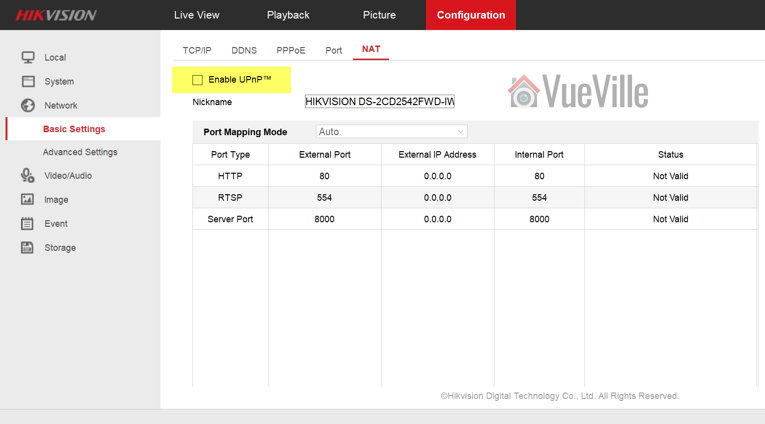
    Here’s how you disable uPNP on Hikvision cameras and NVRs:
    Log in to your Hikvision’s web admin page and navigate to Configuration > Network > Basic Settings > NAT. Make sure Enable uPnP is not ticked and click Save.

    Hikvision - Disable uPNP - VueVille

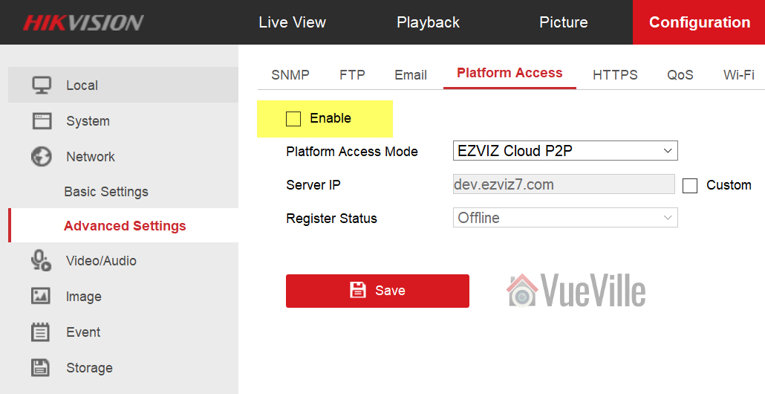
    Disable P2P

    The next one to disable is P2P. Hikvision calls it Platform Access. You will find this in Configuration > Network > Advanced Settings > Platform Access. Make sure the check box for Enable is not ticked and click Save.

    Hikvision - Disable P2P - VueVille

    Also read:

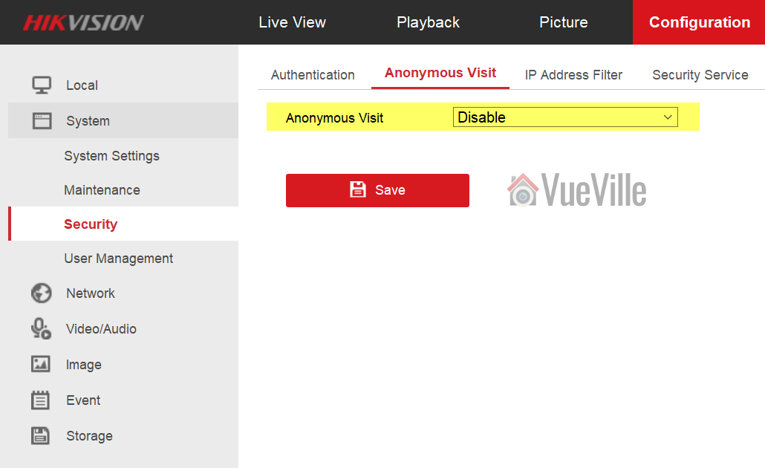
    Disable Anonymous Visit

    You are going to find it under Configuration > System > Security > Anonymous Visit. Disable Anonymous Visit and click Save.

    Hikvision - Disable anonymous visit - VueVille

    Disable SSH

    You are going to find it under Configuration > System > Security > Security Service. Now uncheck “Enable SSH” and click Save.

    Hikvision - Disable SSH - VueVille
  • Best Indoor IP Camera – 2024 Recommendations

    Best Indoor IP Camera – 2024 Recommendations

    I believe a DIY home security camera system is not complete unless it has indoor cameras. Outdoor cameras are great for securing your home’s perimeter and alerting you to an intrusion, but what if the intruder has already entered your home?

    That’s why you need smartly placed indoor IP cameras to hopefully capture identifying features of the intruder so that law enforcement can take them down!

    BEST BUDGET
    Amcrest ASH21
    Amcrest 1080P WiFi Camera Indoor, Nanny Cam, Dog Camera, Sound & Baby Monitor, Human & Pet Detection, Motion-Tracking, Phone App, Pan/Tilt Wireless IP Camera, Night Vision, Smart Home ASH21-W
    ×
    Product prices and availability are accurate as of the date/time indicated and are subject to change. Any price and availability information displayed on https://www.amazon.com/ at the time of purchase will apply to the purchase of this product.
    1080p (2MP) sensor
    Wi-Fi / Ethernet
    Person Detection
    Pan-Tilt, Auto-tracking
    BEST OVERALL
    Amcrest IP4M-1041
    Amcrest 4MP ProHD Indoor WiFi, Security IP Camera with Pan/Tilt, Two-Way Audio, Night Vision, Remote Viewing, 4-Megapixel @30FPS, Wide 90° FOV, IP4M-1041W (White)
    ×
    Product prices and availability are accurate as of the date/time indicated and are subject to change. Any price and availability information displayed on https://www.amazon.com/ at the time of purchase will apply to the purchase of this product.
    4MP sensor
    Wi-Fi / Ethernet
    Object detection
    Pan-Tilt, Auto-tracking
    BEST PREMIUM
    Reolink E1 Zoom
    REOLINK Smart 4K UHD Pan & Tilt Dual-Band Wi-Fi 6 Indoor Security Camera with 3X Optical Zoom, Auto-Tracking, People/Pet Detection, Crying Sound Detection, Privacy Mode, and Bluetooth Setup, E1 Zoom
    ×
    Product prices and availability are accurate as of the date/time indicated and are subject to change. Any price and availability information displayed on https://www.amazon.com/ at the time of purchase will apply to the purchase of this product.
    5 MP sensor
    Dual-band Wi-Fi
    Optical zoom

    At the end of this article, you will also find my thoughts on some other popular IP cameras and why they didn’t make the cut.

    A quick note: As an Amazon Associate I earn from qualifying purchases. This post contains affiliate link(s). An affiliate link means I may earn advertising or referral fees if you make a purchase through my link, at no extra cost to you.


    [wpsm_titlebox title=”Contents” style=”main”][contents h2 h3][/wpsm_titlebox]

    Best Indoor IP Cameras – My 2024 Recommendations

    The cameras I have selected fall into two categories:

    1. Pan-Tilt (PT)
    2. Pan-Tilt-Zoom (PTZ)

    Every IP camera I recommend below meets the must-have feature of fully local operation that is essential for a self-hosted smart home. This means these cameras are not cloud-reliant, not Internet-reliant and have zero monthly fees or subscription plans for basic things such as recording and viewing footage.

    Using a NAS NVR, CCTV software like Blue Iris or just Home Assistant integrations (like I do), you can use these cameras to intelligently detect motion and take action automatically.


    Amcrest 1080P WiFi Camera Indoor, Nanny Cam, Dog Camera, Sound & Baby Monitor, Human & Pet Detection, Motion-Tracking, Phone App, Pan/Tilt Wireless IP Camera, Night Vision, Smart Home ASH21-W
    ×
    Product prices and availability are accurate as of the date/time indicated and are subject to change. Any price and availability information displayed on https://www.amazon.com/ at the time of purchase will apply to the purchase of this product.

    Click to view on Amazon

    • 2MP CMOS image sensor
    • 93° Viewing angle, Pan-Tilt
    • 10m IR night vision
    • Built-in mic and speaker
    • Wi-Fi & Ethernet port
    • microSD card slot
    • ONVIF & RTSP protocols
    • Person detection, auto-tracking
    • Baby monitor mode

    (* = affiliate link / image source: Amazon Associates Program)

    Amcrest was one of the earliest brands I featured on my roundups. While Foscam made some very popular cameras, they had several shortcomings and I was never really satisfied with their cameras. Then Amcrest spun off from Foscam and totally disrupted the market with their reasonably priced and well-made cameras such as this Amcrest ProHD 1080p Pan-Tilt WiFi Camera. Amcrest has this unique blend of high-quality hardware, reliable software, and great after-sales support that makes it easy to recommend any of their products.

    This extremely affordable camera has an Ethernet port, 2.4 GHz WiFi, built-in InfraRed LEDs for very good night vision, clear 2-way audio with mic and speaker, built-in SD card local storage, and on top of all this, AI person detection and even a dedicated baby monitor mode.

    Amcrest has smartphone apps for both iOS and Android. The camera does not need an Internet connection to be set up or for functioning normally. So it can work in a fully standalone manner. But in case you need it, a cloud subscription plan for 1 year is included with the camera.

    Even though there is an Ethernet port, this Wi-Fi model doesn’t support Power-over-Ethernet (PoE). There is no PoE model available, but you can use a PoE injector to carry both power and data over a single Ethernet cable. The downside is that you will have to split them again at the other end before plugging in the camera.

    Amcrest 4MP ProHD Indoor WiFi, Security IP Camera with Pan/Tilt, Two-Way Audio, Night Vision, Remote Viewing, 4-Megapixel @30FPS, Wide 90° FOV, IP4M-1041W (White)
    ×
    Product prices and availability are accurate as of the date/time indicated and are subject to change. Any price and availability information displayed on https://www.amazon.com/ at the time of purchase will apply to the purchase of this product.

    Click to view on Amazon

    • 4 MP CMOS image sensor
    • 90° Viewing Angle, Pan-Tilt
    • 10 m IR range
    • Built-in mic and speaker
    • Audio in/out ports
    • 2.4 GHz Wi-Fi & Ethernet port
    • Up to 128 GB microSD card supported
    • ONVIF and RTSP protocols supported
    • Object detection, auto-tracking

    (* = affiliate link / image source: Amazon Associates Program)

    The Amcrest IP4M-1041W is a stylish 4MP indoor IP camera that works with Amazon Alexa also. It can pan and tilt, but not zoom. The fixed lens has a decent wide angle of 90°. Wi-Fi can be tricky in the furthest corners of your home, so this camera supports both 2.4 GHz and 5.0 GHz bands. For the bitrates that such cameras typically use, 2.4GHz is more than enough and gives you maximum range. But to make use of higher resolutions, the 5 GHz band is best.

    Even though there is an Ethernet port, this camera doesn’t support Power-over-Ethernet (PoE). There is no PoE model available, but you can use a PoE injector to carry both power and data over a single Ethernet cable. The downside is that you will have to split them again at the other end before plugging in the camera.

    This camera does not have person detection for smart notifications, but it can detect moving objects and has auto-tracking. This is a great feature which allows for motion detection recording that will keep the camera trained on the moving object at all times.

    REOLINK Smart 4K UHD Pan & Tilt Dual-Band Wi-Fi 6 Indoor Security Camera with 3X Optical Zoom, Auto-Tracking, People/Pet Detection, Crying Sound Detection, Privacy Mode, and Bluetooth Setup, E1 Zoom
    ×
    Product prices and availability are accurate as of the date/time indicated and are subject to change. Any price and availability information displayed on https://www.amazon.com/ at the time of purchase will apply to the purchase of this product.

    Click to view on Amazon

    • 5 MP CMOS sensor
    • 48-98° Viewing angle zoom, Pan-Tilt for 360° view
    • 12 m / 40 ft IR night vision
    • Built-in mic and speaker, full-duplex
    • Dual-band Wi-Fi (2.4/5 GHz)
    • microSD card slot
    • ONVIF & RTSP protocols supported

    (* = affiliate link / image source: Amazon Associates Program)

    Reolink is a very DIY-friendly security camera company. In fact they are my favourite for affordable no-nonsense well-built cameras that respect our privacy.

    All non-battery powered Reolink cameras support the ONVIF standard. This lets you use them with any 3rd party NVR, NAS NVR or software such as Blueiris which supports the ONVIF standard. The RTSP video streaming protocol is also supported, so I have integrated the camera with my DIY home automation system built around Home Assistant.

    The Reolink E1 series of indoor IP cameras are noticeably smaller than previous models and come only in white colour. So it blends into the background much better and can easily go unnoticed on a bookshelf. The tennis-ball shaped body fully encases the eye-ball style lens. The E1 Zoom has pan-tilt as well as optical zooming capability.

    With the 5 Megapixel resolution, you get great video quality and sharp detail. You can use motion detection to record clips to the microSD card, send push or email notifications and even trigger an audible siren to scare off intruders. Of course you can also immediately push the 2-way talk button in the app to talk to whoever is in front of the camera.

    You can configure the camera through the Reolink mobile app, or more fully through the Web User Interface (UI). The Reolink Client desktop PC app is also available if you prefer to manage multiple Reolink cameras in one interface. What’s more, ONVIF and RTSP support make it a breeze to add this camera to smart home software such as Home Assistant or Blue Iris.

    Smart motion detection methods such as person/animal or advanced method such as line-crossing/intrusion detection are missing. This also means that auto-tracking is not available.

    If you don’t need the optical zoom, the E1 Pro is identical to the E1 Zoom but without the optical zoom feature and the Web UI. Check out my full review below:
    [wpsm_top postid=8537]


    The ones that didn’t make the cut

    A couple of years ago, most camera manufacturers figured out that a better way of making money is to sell you cameras that are crippled and become expensive paperweights unless you hook them up to the Internet and (in most cases) pay a hefty monthly subscription – all for the luxury of using your security camera that you already paid for. I am an engineer and one thing that I learnt pretty early on is that you always have to look at the Total Cost of Ownership (TCO) when comparing any two products. You would be just wasting your money if you bought an ultra cheap product which then needs a monthly investment to keep working for the rest of its life.

    The same TCO concept applies when you buy a camera. The TCO of cloud cameras which requires a monthly subscription is very high compared to a self-sufficient camera which has a one-time cost.

    Nest Cam:
    It was and probably still is the most over-rated security camera ever. Even with the new IQ model, this is a very poor security camera. First off, it cannot work without an Internet connection, it has no local storage so it can only record to the Google cloud, and what’s worse it stores only 3 hours of footage unless you pay up for the Nest Aware cloud subscription ($10/mo per camera at the moment, discount available for additional cameras).

    Instead of pushing out gimmicks such as person detection and face identification, they should make the camera 100% reliable by giving it at least a local backup storage location like the Netgear Arlo Q does, making it less Internet-reliant.

    Logitech Circle and Circle 2:
    Last year, Logitech launched the Circle which was an overpriced attempt at competing with the Netgear Arlo and Nest Cam. Now they have launched the Logitech Circle 2 which is an outdoor camera in both wired and wire-free flavours. Regardless of whether its the original Circle or the new Circle 2, both lack a local storage option and are reliant on an Internet connection to the Logitech cloud servers. If you don’t pay for the monthly subscription, you have access to the last 24 hours recorded footage but no motion zones and advanced alerts.

    Canary All-in-One Home Security:
    I am not a big fan of all in one security devices, mainly because they are full of compromises made to still keep the device within a reasonable price point. The Canary is one of many such I-can-do-it-all devices in the market today. Not only does it do home security, it does home health as well with sensors to monitor air quality. Now if I could do something useful with this sort of information locally such as turn on my dehumidifier or air filter, I would have been mildly interested. It may be possible through IFTTT but again this is Internet-reliant. Sadly, this device is also 100% cloud-reliant. I do not want to be locked into any single manufacturer’s eco-system and then end up paying a cloud subscription fee, but that’s the case with Canary! So in short, the Canary is crippled if the cloud servers decide to take a hike – not great when it comes to protecting your family.

    Piper NV All-in-One Home Security:
    Piper burst onto the all in one security device market with a bold promise – no monthly fees. Yet it is 100% reliant on the cloud because it has no local storage options. There is no SD card or USB drive option available with the Piper NV. But it strangely has some elements of a DIY home automation system, it’s a ZWave hub as well. So its less locked-in and proprietary than others of its ilk. But don’t be deceived, this device is designed to be reliant on the Piper cloud servers: it still can do only 100 recorded clips of up to 35 seconds each before you are asked to start paying a monthly subscription fee.

    That’s not a whole lot especially if for some reason you get a lot of false alerts. Its very interesting that while the Piper NV has battery backup in case of power loss, it has absolutely nothing to protect it from an Internet outage or if their cloud servers go down. What would happen in such a situation? A burglar breaks in, the Piper motion detection is activated, but your Internet connection is disabled or the cloud servers are unavailable and the Piper cant record its video clips! Great for the burglar, not so great for you. Bummer.

    Granted, companies like Piper are bringing innovation to the home security market, but if they expect us to trust them 100% for our home security, the products need to be as close to 100% reliable as possible. This blog is hosted on a VPS that has a Service Level Agreement that promise a 99.9% up-time for example. My point is no cloud server has a 100% up-time, so what happens when the inevitable service disruption happens? Well folks, don’t rely on anybody’s cloud. Build your own local DIY home security system like I have!

    Zmodo Sight:
    Last year I commended the Zmodo Pivot for having local storage in the form of 16GB onboard memory and not being cloud-reliant. While this is still the case, Zmodo is going the way of all the other cloud-reliant camera makers and appears to not let you view continuous video recordings or alert clips more than 12 hours old, unless you pay the monthly cloud subscription fee. No thanks.

    Yi Cam:
    The Yi camera is possibly the cheapest IP camera you can get these days. Being nearly half the price of the cheapest mainstream brands sets off alarm bells for me right away. Yes being a Chinese brand, designed and owned by a Chinese company (Xiaoyi) does help keep costs down but surely there must be some trade-offs?

    Yep, there’s no such thing as a free lunch. The Yi family of cameras work only with their smartphone apps and are 100% reliant on the cloud servers, these cameras don’t even have a web interface for you to use locally! Moreover, the company has been severely criticized by its users for its draconian terms and conditions of use. My recommendation – steer well clear of this and other unheard of Chinese brands.

    Amazon Cloudcam:
    Amazon’s effort to integrate even more into your life (not just shopping), the Cloudcam naturally requires an internet connection and a connection to the Amazon cloud to function. Not fit for home security then.


    What to look for in an indoor IP camera

    The most important must-have features to look for in an indoor security camera are:

    • Video Resolution – In 2022, 720p cameras are just not acceptable. They simply don’t have the resolution to meet the very high threshold that the police and courts require to achieve a conviction. Unless the intruder’s face is right up against the camera, 720p is just not going to capture enough detail to identify a person, especially in the dark. So, my minimum recommendation remains 1080p Full HD (or 2 Megapixels).
    • Field of view or horizontal viewing angle – This depends on the focal length of the camera lens. The wider the horizontal viewing angle, the more flexible the camera is going to be for placement in a tricky place such as a wide living room. Some manufacturers quote the diagonal angle which can be misleading as its always going to be higher than the horizontal one – like how TV screens are marketed! All viewing angles in this article are horizontal values.
    • Night vision – InfraRed night vision is crucial for getting good quality night shots. A true IR cut filter helps to produce true colour images during the day and high quality images at night. EXIR LEDs are brighter and have longer lifespans than the typical IR LEDs used in cheaper cameras.
    • Audio – Most indoor cameras have a built-in microphone, this is great for recording incriminating evidence. It should also have a built-in speaker.
    • Should not be Cloud-reliant – I feel very strongly about privacy and being in control of my data. The trend in recent years has been to create ‘cloud’ cameras that are reliant on the manufacturer’s cloud servers to do even basic things such as motion detection and event recording. Why? Because the cloud subscriptions that you are then forced to pay generates a steady stream of income for the manufacturer for years to come.The worst of the lot are camera that are absolutely crippled and cannot operate without an internet connection – these are the most dangerous because the whole point in having a security camera is that its going to be watching your home 24/7. Since many manufacturers still don’t have reliable cloud servers and an intruder can easily disable your internet connection, how can you be assured that your camera will notify you in time if a break-in is in progress? What you want is a camera that does not need any outside help to do its job – all it should need is electricity. I use a CyberPower UPS to provide backup power in case the burglars cut the power.
    • RTSP stream capable so that you can access the video stream from a 3rd part app such as tinyCam Monitor Pro or IP Cam Viewer. ONVIF support is ideal so that you can connect the camera to an NVR like Amcrest NVRs which can support any ONVIF compatible camera.

    The nice-to-have features to consider are:

    • Wireless – While an Ethernet cable connection is more stable and hence more reliable, support for WiFi and/or Bluetooth is great if you have to install the camera in a spot you can’t run a data cable to. Please do not install only wireless cameras – make sure you have wired cameras also in case your wireless cameras fail for whatever reason.
    • Continuous Video Recording – Most indoor camera will have automatic event triggered recording, but not all support continuous video recording. Typically a Network Video Recorder (NVR) or NAS is needed for this function because recording 24/7 to as SD card will damage it easily. You can specify how many days worth of storage you want to keep, and the older videos will be automatically overwritten.
    • Audio – Most cameras that have a mic and speaker built-in are not full-duplex – they are half-duplex meaning you cannot carry on a conversation in a natural way, you will have to adopt a walkie-talkie style of talking over the camera. So look for full-duplex capability.
    • Software features – Email alerts on motion detection, audio detection, echo cancellation and push notifications to smartphone apps.
    • Local storage – I love using local storage such as an SD card as a secondary location for motion triggered clips. 100% cloud-reliant cameras will not have any local storage, but some cloud cameras like the Arlo Q Plus now feature local storage in case the Internet connection is unavailable. In my opinion, the best cameras are the ones whose cloud features are strictly optional and let you access their video stream using 3rd party apps like tinyCam Monitor Pro.
    • Motion detection method – While software based image change detection is the most common motion detection method, a PIR motion sensor is preferable to cut down on false alerts
    • Power source – A wired Ethernet port is preferable over wireless connections for the best reliability. PoE (Power over Ethernet) support is ideal since then you don’t need two cables to each camera. An internal battery for power backup purposes is great if a burglar cuts the power supply to disable your home defences.
    • Advanced features – Preferably a full API should be available for interfacing with home automation controllers such as the Vera Plus. IFTTT is not enough because it relies on an Internet connection and so is not a local solution.
  • Best Outdoor IP Camera – 2024 Recommendations

    Best Outdoor IP Camera – 2024 Recommendations

    Picking the right IP camera for your DIY Smart Home is tough, I know. Your time is valuable, and what you need is solid, well-researched, actionable advice that you can use right now.

    Since 2015, VueVille has built up a reputation for providing exactly that sort of buying advice. And I don’t take that responsibility lightly.

    So I have created this brand new up-to-date list of the best outdoor IP cameras for 2024 and here are my top picks:

    BUDGET 4K PICK
    Reolink RLC-820A
    [easyazon_image align=”center” height=”160″ identifier=”B08135WDZW” locale=”US” src=”https://m.media-amazon.com/images/I/31Ea0pBsW7L._SL160_.jpg” tag=”vueville.com-eaz-fbox-20″ width=”160″]
    [easyazon_link identifier=”B08135WDZW” locale=”US” tag=”vueville.com-eaz-fbox-20″]Check Amazon Price[/easyazon_link]
    BEST 4K OVERALL
    Amcrest IP8M-T2669EW
    [easyazon_image align=”center” height=”160″ identifier=”B08CWGJY37″ locale=”US” src=”https://m.media-amazon.com/images/I/41pfNMA4UtL._SL160_.jpg” tag=”vueville.com-eaz-fbox-20″ width=”160″]
    [easyazon_link identifier=”B08CWGJY37″ locale=”US” tag=”vueville.com-eaz-fbox-20″]Check Amazon Price[/easyazon_link]
    BEST 4K PTZ
    Reolink RLC-823A
    [easyazon_image align=”center” height=”160″ identifier=”B095H2BBWZ” locale=”US” src=”https://m.media-amazon.com/images/I/31Hde2DPoQL._SL160_.jpg” tag=”vueville.com-eaz-fbox-20″ width=”160″]
    [easyazon_link identifier=”B095H2BBWZ” locale=”US” tag=”vueville.com-eaz-fbox-20″]Check Amazon Price[/easyazon_link]

    I separated indoor IP cameras into its own guide. At the end of this article, you will find our recommendations for specific purposes like battery powered cameras.

    A quick note: As an Amazon Associate I earn from qualifying purchases. This post contains affiliate link(s). An affiliate link means I may earn advertising or referral fees if you make a purchase through my link, at no extra cost to you.


    [wpsm_titlebox title=”Contents” style=”main”][contents h2 h3][/wpsm_titlebox]

    Best Outdoor IP Camera – 2024 Recommendations Summary

    Here’s a handy summary of all our outdoor IP camera recommendations for 2024, split by use case:

    [table id=70 responsive=scroll /]

    Recommendation Methodology

    IP cameras come in all shapes and sizes. There are a few ways we can categorize them:

    • By location – outdoor or indoor.
    • By form-factor: Turret (aka eye-ball) cameras are my favourite type and are highly flexible in how you can point the lens, even after installation. Bullet style cameras are most visible and are great if you prioritize deterrence, whereas dome style cameras are excellent for vandal resistance.

    So I will split this Best IP Camera round-up into two posts: outdoor/indoor camera. In each post, I will also cover the best cameras of each form factor.


    Best Outdoor IP Cameras – My 2024 Recommendations

    Overall Best Budget 4K Camera: Reolink RLC-820A

    [easyazon_image align=”center” height=”500″ identifier=”B08135WDZW” locale=”US” src=”https://m.media-amazon.com/images/I/31Ea0pBsW7L._SL500_.jpg” tag=”vueville.com-eaz-boipc18-20″ width=”500″]

    Click image to view on Amazon

    • 8MP CMOS image sensor
    • 87° Viewing Angle
    • 30m/100ft Ring IR night vision
    • PoE, ONVIF & RTSP
    • IP66 weather-proof
    • Metal body
    • Simple & Smart motion detection
    • Built-in mic

    [easyazon_link identifier=”B08135WDZW” locale=”US” tag=”vueville.com-eaz-boipc18-20″]Check Price on Amazon[/easyazon_link]

    I started reviewing Reolink products in 2017 and have been impressed with the consistently high quality yet affordable products they have put out. Reolink continues to be our favourite for budget-friendly outdoor IP cameras in 2024.

    Last year, the RLC-520A was replaced by the RLC-820A and it continues to be a great choice. Smart motion detection of people and vehicles is becoming more common across Reolink’s model range. I would place these person and vehicle detection features between basic and advanced motion detection of the old classics, Hikvision and Dahua. Yes other brands such as Nest and Arlo also have smart detection but those require rely on the cloud for this to work – no Internet connection means no smart motion detection.

    Reolink not only does the smart motion detection locally but importantly does this without asking you to pay a monthly subscription fee. That’s huge and kudos to Reolink for bucking the trend here.

    The RLC-820A is a turret style camera. There is a true IR cut removable filter (ICR) to ensure excellent night time videos and faithful colour reproduction during the day. Noise reduction and backlight compensation are also available.

    One of the features I look for and often fail to find in budget cameras is our beloved built-in NVR feature. All Reolink standalone IP cameras including the RLC-820A have this feature. It’s great if you are just starting out and have a single camera or do not have a dedicated NVR. So you can set up the camera to do basic or smart motion detection, record to NVR/FTP or the onboard SD card, and it will overwrite older videos automatically.

    The camera doesn’t support continuous recording to the on-board SD card, which is fine because its not something I recommend anyway. You will just end up wearing out the SD card sooner. SD cards are best suited to intermittent motion detection clips being written, rather than continuous data recording. The cameras can instead record to a Reolink NVR or any 3rd party NVR or software that supports the ONVIF standard and RTSP protocol.


    Best Value 4K Turret Camera: Amcrest IP8M-T2669EW-AI

    [easyazon_image align=”center” height=”500″ identifier=”B08CWGJY37″ locale=”US” src=”https://m.media-amazon.com/images/I/41pfNMA4UtL._SL500_.jpg” tag=”vueville.com-eaz-boipc18-20″ width=”500″]

    Click image to view on Amazon

    • 8MP CMOS sensor
    • 108° Viewing Angle
    • 30m EXIR night vision
    • True 120dB WDR
    • ONVIF and RTSP protocols supported
    • IP67 weatherproof rating
    • Metal body construction
    • SD card slot on-board
    • Simple, Advanced & Smart motion detection

    [easyazon_link identifier=”B08CWGJY37″ locale=”US” tag=”vueville.com-eaz-boipc18-20″]Check Price on Amazon[/easyazon_link]

    Amcrest cameras are actually rebranded Dahua cameras. While Dahua doesn’t really support retail customers, Amcrest is purely targeted at retail customers like you and me. And the cost is about the same. So why not go for something that you can buy with 100% peace of mind with a full warranty and the ability to return to Amazon if you don’t like it.

    While Amcrest cannot match the price points that Reolink hits, they differentiate their products by adding a few premium features without a huge price tag. Features like true 120dB Wide Dynamic Range (WDR) and advanced motion detection methods like tripwire (line crossing) and intrusion detection.

    The Amcrest IP8M-T2669EW-AI is an extremely feature-loaded 4K IP camera. It has several highlights such as wide-angle lens, 120dB true Wide Dynamic Range for better shadow detail, extremely bright EXIR IR LEDs, and perhaps most importantly every type of motion detection you cant think of – simple zone-based method, advanced methods such as tripwire (line-crossing) and intrusion, and smart person/vehicle detection. Combining these methods means that you can virtually eliminate false alerts.

    The AI in the model name refers to the smart motion detection that is performed locally and does not need an Internet or cloud connection to work. Nor do you need any sort of paid subscription. This is similar to Reolink’s strategy and great for local-only smart home enthusiasts like us.

    Unfortunately the IP8M-T2669EW-AI does not have audio or alarm in/out connections. But that’s the only thing that is missing in an otherwise excellent package.


    Best Budget 4K Dome Camera: Amcrest IP8M-2493EW-V2

    [easyazon_image align=”center” height=”500″ identifier=”B077Y52782″ locale=”US” src=”https://m.media-amazon.com/images/I/41GcBO8PYFL.jpg” tag=”vueville.com-eaz-boipc18-20″ width=”500″]

    Click image to view on Amazon

    • 8MP CMOS sensor
    • 105° Wide Viewing Angle
    • 30m EXIR night vision
    • True WDR, 10Mbps bitrate
    • SD card, Power over Ethernet (PoE)
    • ONVIF & RTSP protocols supported
    • IP67 weather-proof, IK10 vandal-resistance
    • Simple & Advanced motion detection
    • Metal body

    [easyazon_link identifier=”B077Y52782″ locale=”US” tag=”vueville.com-eaz-boipc18-20″]Check Price on Amazon[/easyazon_link]

    In past years, Dahua featured prominently in this guide. But once again you won’t find any Dahuas here in 2024. The reason is that Amcrest cameras are just rebranded Dahua cameras. While Dahua doesn’t really support retail customers, Amcrest is purely targeted at retail customers like you and me. And the cost is about the same. So why not go for something that you can buy with 100% peace of mind with a full warranty and the ability to return to Amazon if you don’t like it.

    The Amcrest IP8M-2493EW-V2 is a great camera for the DIY enthusiast. You get a brilliant 4K camera with the latest Ambarella S3L33M chipset and true 120dB WDR capability, a wide-angle lens and on-board SD card storage.

    Sadly the recent industry trend of removing audio and alarm connections continues with this camera, so check out the Vivotek models at the end of this article if that’s what you need. But on the flipside, advanced motion detection such as trip wire and intrusion detection have been added. But smart detection (people/vehicle) is missing. The camera supports the latest H.265 and H.265+ encoding standards with a very high 10Mbps bitrate.

    By the way, the camera works with Alexa too (not that I would recommend using it that way)!


    Best Value 4K Dome with Optical Zoom: Reolink RLC-842A

    [easyazon_image align=”center” height=”500″ identifier=”B09DPSB9BL” locale=”US” src=”https://m.media-amazon.com/images/I/31JTX6UHU+L._SL500_.jpg” tag=”vueville.com-eaz-boipc18-20″ width=”500″]

    Click image to view on Amazon

    • 8MP CMOS image sensor
    • Motorized optical zoom
    • 27°-96° Viewing Angle
    • 30m/100ft Ring IR night vision
    • PoE, ONVIF & RTSP
    • Smart motion detection and push alerts
    • Built-in mic
    • IP66 weather-proof, IK10 vandal-resistance
    • Metal body

    [easyazon_link identifier=”B09DPSB9BL” locale=”US” tag=”vueville.com-eaz-boipc18-20″]Check Price on Amazon[/easyazon_link]

    If you need the ability to zoom in/out remotely, you need an IP camera with a motorized optical zoom. The Reolink RLC-842A offers 5x optical zoom in the traditional dome-style shape that also offers IK10 vandal resistance.

    So this IP camera is a great choice for exposed installation locations where vandals are expected. The camera does not suffer from IR glare or reflections, so you get that awesome 4K resolution and clarity without any compromise.

    The RLC-842A also supports smart motion detection, it can distinguish between persons and vehicles and send push notifications or email alerts.


    Best Budget 4K Bullet Camera: Reolink RLC-810A

    [easyazon_image align=”center” height=”267″ identifier=”B07K74GWX5″ locale=”US” src=”https://m.media-amazon.com/images/I/31AULS5iDQL._SL500_.jpg” tag=”vueville.com-eaz-boipc18-20″ width=”500″]

    Click image to view on Amazon

    • 8MP CMOS image sensor
    • 101° Viewing Angle
    • 30m/100ft ring IR night vision
    • PoE, ONVIF & RTSP
    • Smart motion detection and push alerts
    • Built-in mic
    • IP66 weather-proof
    • Metal body

    [easyazon_link identifier=”B07K74GWX5″ locale=”US” tag=”vueville.com-eaz-boipc18-20″]Check Price on Amazon[/easyazon_link]

    This is the most recognizable type of security camera – the classic bullet shape. This also makes it a natural choice for a home CCTV system as a very visible deterrent. If a burglar sees one of these, he knows its not worth risking jail time to break into your house. But do make sure that you have got multiple cameras covering your entry/exit points and that your bullet cameras are high up and out of reach of vandals, because a well-aimed missile can potentially knock it off target.

    The 8mp RLC-810A is the upgraded version of last year’s 5MP RLC-510A. Just like the other Reolink cameras in this article, you get a high-quality camera with smart person and vehicle detection. But unlike the turret cameras, you don’t get EXIR LEDs for night vision, just the standard ring-style IR LEDs. Still, these are plenty fine for most users.


    Best Value 4K Bullet Camera: Amcrest IP8M-2696EW-AI

    [easyazon_image align=”center” height=”311″ identifier=”B0837485XG” locale=”US” src=”https://m.media-amazon.com/images/I/317-tgxNI0S._SL500_.jpg” tag=”vueville.com-eaz-boipc18-20″ width=”500″]

    Click image to view on Amazon

    • 4K 8MP CMOS image sensor
    • 108° viewing angle
    • 30m EXIR LED night vision
    • True 120dB WDR
    • PoE, ONVIF & RTSP supported
    • Simple, Advanced, & Smart motion detection
    • IP67 weatherproof
    • Audio and alarm in/out
    • Metal body

    [easyazon_link identifier=”B0837485XG” locale=”US” tag=”vueville.com-eaz-boipc18-20″]Check Price on Amazon[/easyazon_link]

    The Amcrest IP8M-2696EW-AI is powered by a Sony Starvis image sensor and Ambarella S3LM chipset that can put out UltraHD 4K video at 15 fps. At the same time, true 120dB WDR helps to avoid washed-out scenes in bright daylight. Bumping the resolution down to 3MP will result in a max frame-rate of 30 fps. Personally, I am happy with 15 fps as it reduces the disk space required and so extends the hours of video recorded.

    Just like every other camera in this article, this Amcrest also sports onboard storage. So pop in an SD card (up to 128GB) and the camera can work in a fully standalone manner. It can record motion detection triggered clips and snapshots straight to the SD card without requiring a PC, NVR or anything. This built-in NVR of the Amcrest can be accessed through a web browser or the Amcrest mobile app. The same app also delivers push notifications to your smartphone.

    Uniquely this camera also has audio or alarm connections, that help you to extend the capabilities of this camera. If you dabble with Home Assistant and ESPHome, you can set up some nifty automations using these inputs.


    Best Value Wi-Fi Camera: Reolink RLC-511WA

    [easyazon_image align=”center” height=”500″ identifier=”B08QV8T3D9″ locale=”US” src=”https://m.media-amazon.com/images/I/31abCrEzq8L._SL500_.jpg” tag=”vueville.com-eaz-boipc18-20″ width=”500″]

    Click image to view on Amazon

    • 5MP CMOS sensor
    • 27-96° Viewing Angle
    • 2.7-8mm Motorized Optical Zoom
    • 30m/100ft EXIR night vision
    • Standard LEDs for colour night vision
    • SD card slot, PoE, ONVIF & RTSP supported
    • Built-in mic and speaker
    • RJ-45 Ethernet port present
    • IP66 weatherproof rating
    • Metal body

    [easyazon_link identifier=”B08QV8T3D9″ locale=”US” tag=”vueville.com-eaz-boipc18-20″]Check Price on Amazon[/easyazon_link]

    Now I have to say this upfront: the only time I recommend Wi-Fi cameras is when you cannot conveniently wire the camera up at your installation location & you have another wired camera covering the same viewing area. Why because Wi-Fi cameras are simply never going to be as reliable as a wired camera. That said, they do have their place.

    For a Wi-Fi camera, you are constrained by available bandwidth. So the maximum 5MP resolution is plenty fine and in fact I would suggest a lower resolution to avoid dropped frames if you are placing the camera well away from the nearest Wi-Fi access point.

    A major highlight is the motorized optical zoom that you can control from the excellent Reolink mobile app. I also like that even though the camera is wireless, it has an Ethernet port that allows it to be used as a wired camera as well! That’s a great touch, even though its not PoE capable.


    Best Auto-tracking PTZ: Reolink RLC-823A

    [easyazon_image align=”center” height=”500″ identifier=”B095H2BBWZ” locale=”US” src=”https://m.media-amazon.com/images/I/31Hde2DPoQL._SL500_.jpg” tag=”vueville.com-eaz-boipc18-20″ width=”500″]

    Click image to view on Amazon

    • 5MP CMOS sensor
    • 2.8-13.5mm motorized varifocal lens, with pan-tilt
    • 27°-96° Viewing Angle
    • 60m/200ft EXIR LED Range
    • Spotlight for colour night vision
    • Built-in siren
    • Power over Ethernet (PoE 802.3at)
    • IP66 weatherproof
    • Smart (Person/Vehicle) with Auto-tracking
    • Built-in mic and speaker

    [easyazon_link identifier=”B095H2BBWZ” locale=”US” tag=”vueville.com-eaz-boipc18-20″]Check Price on Amazon[/easyazon_link]

    I first reviewed the 4MP version of the Reolink RLC-423 in 2017 and were very impressed with the quality and features that Reolink managed to cram into this PTZ at a very affordable price. In 2020 Reolink launched the 5MP version of the same camera and last year Reolink upgraded it to the 4K 8MP RLC-823A.

    The most important upgrades are smart person detection with auto-tracking, on-board SD card storage, spotlight LEDs for colour night vision and a siren. With these features, the RLC-823A becomes the best value PTZ on the market.

    Check out our review of the original 4MP RLC-423 PTZ.


    Best Outdoor IP Cameras for specific purposes

    Best Battery-Powered Outdoor Camera

    Reolink Argus 3 Pro:
    Wire-free or battery operated Wi-Fi cameras became mainstream a couple of years ago and I started reviewing them on VueVille. I wouldn’t recommend using only battery powered cameras in your DIY security camera system because they are not a 100% reliable. Batteries will run out, or fail at the most inopportune moment. But as a secondary camera covering areas already covered by mains powered or PoE cameras, wire-free cameras are an excellent choice.

    The Argus 3 Pro has a 4MP sensor and coupled with with PIR motion sensing and SD card storage, its a perfect DIY IP camera. Being battery powered, you can’t really expect it to support RTSP or ONVIF. But it does have colour night vision, 2-way audio, pre-motion recording, person/vehicle detection, large built=in battery, solar panel support, IP65 weather-proofing and Google Assistant support.

    The other new models include the Argus Lumus and the Argus Eco which is the only bullet-style battery powered camera I have seen.

    Check out our detailed review of the Argus below:

    [wpsm_top postid=4415]

    [easyazon_link identifier=”B08S7Q3BSH” locale=”US” tag=”vueville.com-eaz-boipc18-20″]Check Price on Amazon[/easyazon_link]


    Best Outdoor Spotlight Camera with Colour night vision

    Reolink RLC-824A:
    If you are looking for a spotlight camera with excellent colour night vision, check out our hands-on review of the RLC-824A.

    [wpsm_top postid=11942]

    [easyazon_link identifier=”B099ZPF3B2″ locale=”US” tag=”vueville.com-eaz-boipc18-20″]Check Price on Amazon[/easyazon_link]


    What to look for in an outdoor security camera

    Every year IP camera technology advances and you get more features for your money. But what exactly should you be looking for? The most important must-have features to look for in an outdoor security camera are:

    • Video Resolution – at least 4MP resolution. This is to ensure an increased chance of positive identification of faces, especially at night. 4MP is recommended as it costs no more than 3MP models these days and you can also fall back on the 2MP(1080p) or 3MP setting if you want to reduce bandwidth usage and disk space usage.
    • Field of view – at least 80 degrees horizontally. This depends on the focal length of the camera lens. The shorter the focal length, the wider the field of view. Ignore diagonal measurements, what matters is horizontal field of view.
    • Night vision – Should at least have InfraRed LEDs for night vision with an auto IR cut filter to avoid false colour in the daytime.
      Every camera I recommend in this article has an auto IR cut filter.
    • Weather proofing – Expressed in IP ratings, the first digit is the solid ingress rating and the second digit is the water ingress rating (higher is better always). An X instead of a number indicates a product is unrated for that component. An IP weather-proof rating is preferable, IP66 is the standard for good security cameras. Vandal resistance is expressed in the IKXX rating and is good to have in high traffic areas.
    • Should not be Internet or Cloud reliant – Can the security camera function without an internet connection? Do you have to pay a monthly subscription for core features such as recording video clips, storing them, accessing them later on, for motion detection? I only recommend cameras that do not need an Internet connection to function, are not cloud reliant and have the ability to write video clips and images to a local device such as an NVR, a NAS, or SD card. This is because for something as critical as home security, your camera should be able to record and store clips without requiring anything more than just a power source. Get a UPS and you can keep your cameras running even if an intruder cuts your home’s power supply.
    • RTSP stream capable so that third party apps such as camera viewers and Home Automation controllers can access the camera video stream.
    • ONVIF compatibility so that you can connect it to an NVR like the Amcrest which can support any ONVIF compatible camera.
    • Software features – Motion detection, Email alerts on motion detection

    The nice-to-have features to consider are:

    • Wireless – Support for WiFi and/or Bluetooth if you have to install the camera in a spot you can’t run an ethernet cable to. But really I do not recommend going with only wireless cameras for your whole network – Wi-Fi is not that reliable.
    • Continuous Video Recording instead of just automatic event triggered or manual recording. Requires a storage medium though, like an NVR which adds to the cost.
    • Software features – Built-in NVR feature, advanced motion detection methods to reduce false alerts, push notifications to smartphone apps
    • Local storage – in the form of a microSD card slot, or internal flash storage. A built-in NVR function is a plus.
    • Motion detection method – PIR motion sensor is preferable to cut down on false alerts
    • Power source – Ethernet port preferable with PoE (Power over Ethernet) support, internal battery good for power backup purposes
    • Audio – Microphone built-in would be a nice to have, full-duplex capability is superb but very rare
    • Advanced features:
      • API available for interfacing with home automation controllers such as the Vera Plus or Fibaro Home Centre
      • Full duplex 2-way audio support, built-in mic or audio and alarm connections
      • PIR sensor to reduce false alerts

    How to use this IP camera buying guide

    Choosing your own DIY IP cameras can be overwhelming. So if you are brand new to this, it’s a good idea to first read up on IP camera basics. It contains all the frequently asked questions about IP cameras.

    All the cameras I recommend in this article are DIY cameras that are not cloud-reliant or even Internet-reliant. None of them are crippled by their manufacturers to make you pay a monthly fee.

    While I do recommend sticking to one single brand for convenience and maximum compatibility, thanks to the ONVIF and RTSP standards you can mix and match as I have done with our DIY home security camera setup.

    Also if you want to just start with any one of these cameras, you can always continue using them in your future setup that also supports open industry standards such as ONVIF and RTSP.

    How to choose an IP camera if you are new to DIY

    I created the EasyDIY/ProDIY framework to help you choose the best system for your needs:

    • EasyDIY: Check out the Best All-in-one DIY Security Camera Systems with Smart Security
    • ProDIY:
      • Want to start with a single IP camera that can do everything, and maybe expand later with an NVR or NAS NVR? Awesome, that’s how I started! Pick a camera with on-board storage (SD card slot) from the recommendations below.
      • Want to start with a NAS as an NVR, with the freedom to add IP cameras later? Awesome, any camera recommended below will work for you! Skip down to the recommendations below.

    How to choose an IP camera for an existing NVR

    • If your existing NVR doesn’t support ONVIF, choose the same brand IP Camera as your NVR.
    • If your existing NVR supports ONVIF, any camera recommended below will work for you.

    Conclusion

    The wide range of outdoor IP cameras above should give you a good overview of the freedom and flexibility going Pro-DIY brings you. Have I missed a camera that really ought to be on this list? Please leave a comment below – I love hearing from you!

  • Review: Reolink C1 Pro 4MP Wireless Indoor Pan-Tilt IP Camera

    Review: Reolink C1 Pro 4MP Wireless Indoor Pan-Tilt IP Camera

    Reolink recently launched their latest indoor pan-tilt wireless camera, the 4 Megapixel [easyazon_link identifier=”B01LS71HNM” locale=”US” tag=”vueville.com-eaz-20″]Reolink C1 Pro[/easyazon_link]. I got the chance to do a thorough hands-on review and I found it to be a great multi-purpose DIY security camera. With its easy setup, built-in NVR features, full duplex 2-way audio, and dual-band WiFi, its a solid choice for your DIY home security system, especially if you don’t want to be reliant on any cloud service.

    I currently use the Amcrest ProHD 1080p as my son’s baby monitor. Since the Reolink C1 Pro is likely to be pitched as an upgrade to a ‘mere’ 2MP camera and I have been using the Amcrest for over a year, I will be drawing comparisons between these two throughout this review.

    Iso view - Reolink C1 Pro Review Pan-Tilt Indoor Security Camera - VueVille

    [wpsm_titlebox title=”Contents” style=”main”][contents h2][/wpsm_titlebox]

    A quick note: As an Amazon Associate I earn from qualifying purchases. This post contains affiliate link(s). An affiliate link means I may earn advertising or referral fees if you make a purchase through my link, at no extra cost to you.

    Specifications

    [table id=39 responsive=scroll /]

    Unboxing

    Unboxing - Reolink C1 Pro Review Pan-Tilt Indoor Security Camera - VueVille

    The Reolink C1 Pro comes in a nicely packed box with a sufficient level of padding inside to protect the camera. The model name of the camera, and its main specs are clearly listed on a sticker on the outside of the box along with the default login details.

    What’s in the box

    Box Contents - Reolink C1 Pro Review Pan-Tilt Indoor Security Camera - VueVille

    • Reolink C1 Pro Mini PT Camera
    • DC 5V wall adaptor
    • Mini USB cable
    • Ethernet cable (1 metre long)
    • Wall mounting bracket
    • Quick Start guide
    • What’s next booklet
    • Drilling templates
    • CD-ROM with software and manuals
    • Reolink surveillance notification sticker
    • Screws and rawl plugs

    Design & Features

    The C1 Pro is available in only one colour – black. The camera can be divided into three parts – the base, the body and the lens mounting which contains the lens itself. A chrome trim runs around the base, lending it a high-end look and feel.

    Front View - Reolink C1 Pro Review Pan-Tilt Indoor Security Camera - VueVille

    The base has the indicator LEDs on the front (see above) and the connectivity ports on the back. You will find the 10/100 Mbps ethernet port, a microSD card slot and a micro-USB port which serves as the power input. Yes the camera runs on 5V DC which means that you can easily plug it into a USB port to power it. How much amperage would you need? Power = Voltage x Current. Since the camera is rated for a maximum of 6W power usage and runs at 5V, the current requirement is 1.2A. If your USB port is rated for charging devices, its 1.5A rating is more than sufficient to power the camera.

    The dual Wi-Fi antennae are also fixed to the back of the base. Now this is a great feature to have as most of the C1 Pro’s competitors are still sporting just 2.4 GHz Wi-Fi. The antennae are adjustable and so you can orient it to get the strongest Wi-Fi signal.

    You will also find a handy reset pin hole on the side of the base.

    Rear View - Reolink C1 Pro Review Pan-Tilt Indoor Security Camera - VueVille

    The body is the part that rotates around the vertical axis, and has a 355 degree freedom of motion. The body also contains the dual speakers, one on each side as you can see below. The built-in microphone can be found on the front of the body just under the lens mount.

    Side View 1 - Reolink C1 Pro Review Pan-Tilt Indoor Security Camera - VueVille

    Side View 2 - Reolink C1 Pro Review Pan-Tilt Indoor Security Camera - VueVille

    The lens mounting piece is free to rotate about the horizontal plane with 42 degrees of movement. The daylight sensor is integrated into the Ring-type Infrared LEDs concealed smartly around the lens. If you look carefully you can see the red tinge of the Infrared LEDs under the darkened glass surrounding the lens.

    All in all, the camera feels solid in construction and the matte finish of the dark plastic makes it look more expensive than it really is.

    Installation & Setup

    The Reolink C1 Pro comes with a very good quick start guide which is a double-sided glossy booklet, just like the Reolink Argus I reviewed recently. The general introduction section illustrates and labels the different parts of the camera such as the daylight sensor, the built-in mic, the speaker, the indicator LEDs and the various connections.

    There is also a helpful camera connection guide for those who are new to security cameras. Initial setup needs the C1 Pro to be connected to your router via an ethernet cable unlike the Argus which had a niftier setup method. Nope, there’s no voice guiding you through the setup process like the Argus either.

    Since the C1 Pro doesn’t support PoE, you have to use the included power adaptor. The camera uses a standard USB power plug so you may be able to power it using alternative power sources too. The blue power LED will lit up when I turned on the power. There was no ‘startup dance’ or calibration as my Amcrest ProHD 1080p PT does when I power it up, although after the initial setup I noticed it does this whenever I power it on.

    So you have two options for setting up the camera:

    1. Setup using a phone or tablet – the smart device method as Reolink calls it, or
    2. Setup using a laptop

    I suspect most people would opt for the smart device setup, so that’s what I did.

    1. Install the Reolink mobile app. I had it already installed since I use the Reolink Argus.
    2. To my surprise, when I opened the app I found that it detected and added the Reolink C1 Pro automatically! There was a red indicator next to the ‘Init’ button for the C1 Pro. So I turned to the quick start booklet and sure enough it said the camera would be automatically detected.
      Reolink App Initialization - Reolink C1 Pro Review Pan-Tilt Indoor Security Camera - VueVille
    3. Now its time to set up the Wi-Fi. I touched the Wi-Fi symbol for the C1, entered my Wi-Fi network details and then proceeded to perform the Wi-Fi test. The test was successful, so I backed out to the main devices page.
      Reolink App Wi-Fi - Reolink C1 Pro Review Pan-Tilt Indoor Security Camera - VueVille
    4. Next I clicked on the warning message saying ‘Create a password for your device’, and saved a password. The app then opened the camera’s dedicated page with all the control options including the PTZ button and Live View. Backing out to the main devices page showed that the warning message now changed to ‘Connection succeeded’.
      Reolink App Wi-Fi Success - Reolink C1 Pro Review Pan-Tilt Indoor Security Camera - VueVille
    5. Interestingly the quick start guide didn’t say anything about the Init button which still had a red indicator next to it (as you can see above). So I touched it and completed the initial setup. I touched ‘Synchronize phone time’ and then hit Next to complete the setup.
      Reolink App Init - Reolink C1 Pro Review Pan-Tilt Indoor Security Camera - VueVille
      Reolink App Init Complete - Reolink C1 Pro Review Pan-Tilt Indoor Security Camera - VueVille
      Good, now the setup was really complete and the Init button changed into a settings gear button.
      Reolink App Init Complete - Reolink C1 Pro Review Pan-Tilt Indoor Security Camera - VueVille

    Configuring the C1 Pro

    As we saw earlier, the easiest way of setting up the camera is using the app. This is in part because you don’t need to know the camera’s IP address to access it, the app does that part for you. But don’t forget this is not a dumbed down security camera. It has its own web admin page where you can access the advanced settings. But to do this you need to know the IP address of the camera. Since the initial setup requires the camera to be connected physically to your router via the Ethernet cable and DHCP is enabled by default to help newbies, the camera is accessible via that interface’s IP address. You can scan the network using any number of apps to find out the ethernet interface’s IP address.

    If you have set up the Wi-Fi as well, that interface will have a separate IP address. Just like the Amcrest ProHD IP camera, both interfaces are live at the same time and you can choose to access the camera through either one. This is a very nice feature.

    The Web Admin page

    When you first log in to the web admin page, it takes you straight to the Live View page, which Reolink calls the ‘Preview’ tab. Here you can control the PTZ function of the camera, switch between different resolution (clear/fluent/balanced), and access some of the OSD settings. You can also mute the camera audio if required. The web admin page uses Adobe Flash though, I would have preferred an HTML5 interface.

    The playback tab is for accessing the built-in NVR feature of the C1 Pro. What is the built-in NVR feature? Basically, pop in a microSD card and the camera can record continuous or motion detection triggered video clips or snapshots to the SD card. You can login any time from anywhere to review the footage through a timeline view. This means that if you need only a single camera or two in your home , you don’t need to buy a separate NVR just to record video footage. The camera can also push notifications to the Reolink app on your mobile phone, send email alerts with attached snapshots or video clips and even upload them to an FTP server.

    Moving on to the settings page, the various configuration options are neatly laid out in logical sections. You can set the video resolution and frame rates separately for the main stream (called clear stream) or the secondary stream (called the fluent stream). The secondary stream is used for the mobile app live view feature.

    Web admin page - Reolink C1 Pro Review Pan-Tilt Indoor Security Camera - VueVille

    The network section lets you switch between static and dynamic IP allocation (DHCP), and also adjust many other settings such as the various ports used, set up a dynamic DNS ping, email notification setup, FTP settings, and push notifications. I was happy to see that uPNP is disabled by default – this is a great security feature. When ONVIF is available you really do not need uPNP.

    Okay but how does the Reolink app manage to access the C1 Pro and receive push notifications even when you are outside your local network? Well its got to be that favourite protocol of every security camera manufacturer, P2P! Except, Reolink doesn’t call it that – you are looking for the UID setting. It is on by default which is fine for making the camera super easy to set up but for power users like me, I don’t need the C1 Pro to poke a hole through my network and connect to Reolink’s P2P servers. I have my super secure way of accessing my local network remotely through OpenVPN, so I immediately turned off the UID P2P feature.

    Web Admin Page - Reolink C1 Pro Review Pan-Tilt Indoor Security Camera - VueVille

    Adding a microSD card for motion detection recording

    I inserted a microSD card into the SD card slot. I had to push the card all the way into the slot before it click-locked. I then formatted the card through the web admin page. The camera then automatically rebooted and the microSD card was ready for use.

    Web admin page - Reolink C1 Pro Review Pan-Tilt Indoor Security Camera - VueVille

    A word of warning here, by default the camera automatically will then start recording 24/7 to the SD card. I would have been happier to see the default set at ‘None’ or ‘Motion’ instead of ‘Normal’.

    Mobile Push Notifications

    Push notifications can be set up based on the time of the day. Remember that push notifications will not work outside your local network if you switch off P2P though.

    Web Admin Page - Reolink C1 Pro Review Pan-Tilt Indoor Security Camera - VueVille

    Adding the Reolink to QNAP Surveillance Station

    The C1 Pro supports ONVIF, so I was easily able to add it to my QNAP TS-253A’s Surveillance Station app. I first created an additional user for the NAS using the web admin page of the C1 Pro.

    Performance

    Okay so the C1 Pro is a 4 Megapixel camera that can do 30 frames per second, so its no surprise I found things ticking along nicely throughout the review with no slowdowns, frame stutters or any performance issue really.

    Let’s look at the default settings the Reolink C1 Pro comes with from the factory:

    Main stream: 4MP @ 15fps and 3Mbps

    Now I think the default bitrate of 3Mbps is too low but since these are the defaults, I ran my day and night tests at these settings.

    In the System>Performance section of the web admin page, I could see that while idling the processor usage ranged between 10% and 15%. When motion was detected this went up to around 40%, so there was always sufficient headroom for the camera’s processor.

    Video quality

    Video captured was crisp and clear both during the day time and in total darkness, in line with my expectations for a 4 Megapixel IP camera.

    Here are the motion detection triggered videos recorded at the default 4Megapixel resolution, at 30 fps and 3 Mbps bitrate:

    [wpsm_tabgroup]
    [wpsm_tab title=”Daytime Indoors video”][wpsm_video]https://www.youtube.com/watch?v=DnDd13a2HqQ[/wpsm_video][/wpsm_tab]
    [wpsm_tab title=”Night-time Indoors video”][wpsm_video]https://www.youtube.com/watch?v=G_hgYCTsxjU[/wpsm_video][/wpsm_tab]
    [/wpsm_tabgroup]

    There was no blurring of the video and there were no dropped frames.

    Motion detection

    The C1 Pro is able to both pre-record and post-record. This means the camera is able to record not just what happens after motion was triggered but a few seconds before the trigger as well. This is a great feature and something that I always look for in a security camera. The post-record feature lets you decide how many seconds the camera should record after the last motion trigger. The default is 15 seconds.

    Night vision

    The Infrared LEDs are reasonably powerful and can light up a decent sized room. There are no settings to control the brightness of the LEDs and there are no advanced features to dynamically control the infrared light output.

    Audio quality

    Just like most indoor security camera, the C1 Pro supports 2-way audio. Usually the implementation in most manufacturers’ native apps mutes the audio when you activate the microphone. In other words they have half-duplex audio, not full-duplex. Ideally to use the camera as an intercom, you need 2-way full duplex audio.

    Interestingly Reolink has not claimed full duplex audio, however the Reolink app doesn’t mute the incoming audio when you press the microphone button. You can continue to hear what the person at the other end is saying when you are speaking. So the C1 Pro actually supports full duplex audio.

    So how well does it work in practice? The audio quality is great and the dual speakers do a great job in reproducing audio. But there is a noticeable lag, however slight, in audio playback and this makes the full duplex capability less useful. We found ourselves using the Reolink C1 Pro more like a walkie-talkie just like the Amcrest ProHD.

    PTZ performance

    If you are planning to use the C1 Pro as a baby monitor with 2-way audio, you are going to love how quiet it is. One complaint I do have with the Amcrest ProHD camera is how noisy the PT motion is, truly its loud enough to wake up my baby if he is sleeping lightly.

    The C1 Pro hardly makes a sound and so is better suited as a baby monitor. There are no speed control settings though whereas the Amcrest ProHD does. One other drawback I found is that the motion detection stays active even when you use the Pan-Tilt controls which means the camera records a motion detection clip each time you use the PTZ controls.

    Wireless performance

    So I tested the camera over both Ethernet and Wi-Fi. But you know Ethernet is easy for any camera in 2017. What really matters is how good the Wi-Fi connection and performance is. The C1 Pro boasts of 2T2R MIMO antennae for improved wireless performance. So I moved the camera to the farthest point in my house to see how the Wi-Fi did. Over both 2.4GHz and 5 GHz, the C1 Pro was stable and performed just as if it was connected over Ethernet.

    Mobile app live view

    I first installed the Reolink Android app on my phone when I reviewed the RLC-423 PTZ. I then added the Reolink Argus and now the Reolink C1 Pro. I have been quite impressed with the fluid intelligent design of the mobile app, its definitely something that Hikvision for example can learn from. Where the iVMS app is clunky and often doesn’t work, the Reolink app simply delivers.

    Reolink Android App PTZ Controls - Reolink C1 Pro Review Pan-Tilt Indoor Security Camera - VueVille

    Live view on the app can be by camera or you can simultaneously view multiple Reolink cameras. There is a handy PTZ joystick button and the camera is quite responsive when you move the joystick around. Over a remote connection, there was a 0.5 second delay between moving the PTZ controls and the video changing.

    Mobile app push notifications

    So what should you be looking for when it comes to push notifications? The speed and reliability of the push notifications reaching you. You want the camera to send you push notifications immediately after it detects motion. Especially if you have configured email alerts, SD card recording at 4 Megapixel recording and push notifications, inferior cameras may struggle but not the C1 Pro.

    Reolink Android Mobile App Push Notification - Reolink C1 Pro Review Pan-Tilt Indoor Security Camera - VueVille
    Reolink Android Mobile App Push Notification - Reolink C1 Pro Review Pan-Tilt Indoor Security Camera - VueVille

    Inside my local network I got push notifications on my phone instantaneously and on remote networks there was a delay of just 1 second which is very impressive. The success rate of receiving the push notifications over multiple motion triggers was a solid 100%.

    Reviewing recorded footage

    So this is how you access the built-in NVR feature of the C1 Pro. Clips recorded on the microSD card can be accessed either via the web admin interface or the Reolink mobile app.

    Using the web browser interface

    You can choose a date to review and if motion triggered recording is enabled, all these clips will be shown on the timeline. You can roll the mouse wheel to zoom in and out of the timeline to select specific clips. Click anywhere on the timeline and it will jump to the next recorded clip and then keep playing one clip after the other sequentially.

    There is a handy download button which lets you download multiple clips to your computer. Overall great implementation and a very useful feature.

    Reolink Web Browser Playback - Reolink C1 Pro Review Pan-Tilt Indoor Security Camera - VueVille

    Using the mobile app

    The Android mobile app also can access the built-in NVR feature of the C1 Pro. It works just like the web interface – you can choose the date to review and either let it play one motion triggered clip after the other or pick a specific point on the timeline.

     
    Reolink Android Mobile App Playback - Reolink C1 Pro Review Pan-Tilt Indoor Security Camera - VueVille

    Verdict

    There are lots of indoor security cameras available these days – hundreds and hundreds of obscure brands that all promise to meet your indoor security needs. But there are a few brands that stand out – Reolink & Amcrest.

    The super quiet Pan-Tilt motion of the camera calls for special mention, its ideal for discreet use cases or where you don’t want to wake up a baby in light sleep!

    The Amcrest ProHD is available with PoE whereas the Reolink doesn’t have PoE. It would be nice to have the option of choosing between PoE and Wi-Fi.

    [review]

    Where to buy

    [easyazon_link identifier=”B07CPNNT56″ locale=”US” tag=”vueville.com-eaz-20″]Check Price on your local Amazon site[/easyazon_link]

    (* = affiliate link / image source: Amazon Associates Program)

  • How to set up your own DIY NAS NVR using QNAP Surveillance Station

    How to set up your own DIY NAS NVR using QNAP Surveillance Station

    If you have read my DIY home security camera system story, you know that I have gone the FullDIY route and created a DIY NAS NVR system. So I have a single box, the QNAP TS-253A running my entire home security system with redundant RAID storage, an OpenVPN server for secure access from outside the home, email notifications, push notifications, and USB backups. And oh, it also serves as my home file server, DLNA server and mobile device backup destination. Did I say I get all of this in one box that costs less than $500? I love my NAS!

    So you have bought your QNAP NAS and now would like to setup the NAS as an NVR. Here’s a step-by-step guide showing you how.

    [wpsm_titlebox title=”Contents” style=”main”][contents h2][/wpsm_titlebox]

    Installing QNAP Surveillance Station

    1. Go to the App centre and search for surveillance
      How to set up your own DIY NAS NVR using QNAP Surveillance Station - VueVille
    2. Click the Install button and when it is installed, click the open button
      Installing Surveillance Station - How to set up your own DIY NAS NVR using QNAP Surveillance Station - VueVille
    3. Login with your admin account
      Login screen - How to set up your own DIY NAS NVR using QNAP Surveillance Station - VueVille
    4. The next step is to choose a recording folder. I chose to create a new shared folder called ‘Recordings’. Click Apply.
      Recording folder - How to set up your own DIY NAS NVR using QNAP Surveillance Station - VueVille
    5. After a minute, you should reach the Surveillance Station home page
      Surveillance Station - How to set up your own DIY NAS NVR using QNAP Surveillance Station - VueVille
    6. Create a new account with full access in each of your cameras. We will give these login details to Surveillance Station in the next step. Make sure the accounts are of type Operator and not User if you are using Hikvision cameras. Here’s what this looks like in my Hikvision IP camera:
      Hikvision account setup - How to set up your own DIY NAS NVR using QNAP Surveillance Station - VueVille
      Note: If you have trouble getting QNAP Surveillance Station to recognise your cameras, just use the admin account of your camera.

    Adding a camera

    1. Go to Camera Settings and click Camera Configuration
      QNAP Camera Configuration - How to set up your own DIY NAS NVR using QNAP Surveillance Station - VueVille
    2. Now click on the Add button.
      Add Camera - How to set up your own DIY NAS NVR using QNAP Surveillance Station - VueVille
      I like to manually configure my cameras, but you can also have the NAS search for them automatically using uPNP or ONVIF.
      uPNP - How to set up your own DIY NAS NVR using QNAP Surveillance Station - VueVille
      If you have disabled uPNP on your cameras, you will be able to use only the ONVIF or manual setup method.
    3. Select the camera you want to add, enter the camera details and then click TEST.
      Adding a camera - How to set up your own DIY NAS NVR using QNAP Surveillance Station - VueVille
      Make sure you use an account with admin privileges, otherwise you will get a question mark instead of the preview image. Click Next.
    4. Enter the quality settings as desired. Click Next.
      Video quality settings - How to set up your own DIY NAS NVR using QNAP Surveillance Station - VueVille
    5. Enable Schedule recording if you wish to record 24/7. Click Next.
      Schedule settings - How to set up your own DIY NAS NVR using QNAP Surveillance Station - VueVille
    6. Review the settings you have chosen and click Next.
      Confirmation - How to set up your own DIY NAS NVR using QNAP Surveillance Station - VueVille
    7. You should now see the success message.
      Success - How to set up your own DIY NAS NVR using QNAP Surveillance Station - VueVille
    8. Once you have added all your cameras, the camera configuration page will look like this:
      Camera configuration page - How to set up your own DIY NAS NVR using QNAP Surveillance Station - VueVille

    Viewing your cameras

    1. The first time you click on the Monitor button, you will get the following message:
      QMon - How to set up your own DIY NAS NVR using QNAP Surveillance Station - VueVille
    2. Once you install the QMon plugin, you should be able to view all your cameras simultaneously
      Monitor - How to set up your own DIY NAS NVR using QNAP Surveillance Station - VueVille

    That’s it, now you have set up QNAP Surveillance Station to receive video streams from your IP cameras.

    What next?

    Here are some suggested next steps:

  • Arlo Pro vs. Arlo HD

    Arlo Pro vs. Arlo HD

    Arlo Pro vs. Arlo HD - VueVille

    The Netgear Arlo is that once in a century product, that totally revolutionizes the industry by making taking something niche into the mainstream. As I noted in my recent Reolink Argus wire-free camera review, I was initially against battery-powered cameras. But my experience with the Argus blew me away. It forced me to take a fresh look at how a good wire-free camera can help fill out and complete a good DIY security camera system.

    So in the spirit of discovery, I am looking at the Arlo family today. Starting with the [easyazon_link identifier=”B00QH0Q8J4″ locale=”US” tag=”vueville.com-eaz-20″]Arlo[/easyazon_link] and the [easyazon_link identifier=”B075P84FH9″ locale=”US” tag=”vueville.com-eaz-20″]Arlo Pro[/easyazon_link], I will take you through the different features, and talk about which camera is best for which situations.

    The basic idea of the Arlo is this: small 100% wire-free battery-powered cameras that connect to a hub. The hub is then connected to your Wi-Fi network. The Netgear Arlo is lovingly called the Arlo HD by customers, even though Netgear prefers just Arlo. The Arlo Pro is a beefed up version of the Arlo HD and is sort of the big brother of the Arlo HD. Calling the Arlo, the lowest member of the Arlo family ‘HD’ makes sense because it has 720p resolution which is popularly known as HD resolution.

    [wpsm_titlebox title=”Contents” style=”main”][contents h2][/wpsm_titlebox]

    A quick note: As an Amazon Associate I earn from qualifying purchases. This post contains affiliate link(s). An affiliate link means I may earn advertising or referral fees if you make a purchase through my link, at no extra cost to you.

    Arlo HD vs. Arlo Pro – Comparison Table

    Here’s a quick comparison table between the Arlo Pro and the Arlo HD:
    [wpsm_comparison_table id=”14″ class=”hover-col1 “]

    Now let’s look at the main features of these battery-powered cameras head-to-head.

    Video Quality

    Arlo Pro vs. Arlo HD - Arlo Wire-Free - VueVille

    Both the Arlo HD and the Arlo Pro have the same 720p sensor and therefore have similar image quality. 720p is on the lower side and if you need 1080p, you need to go up to the Arlo Q or the Arlo Q Plus which also sports Power over Ethernet.

    Both cameras also feature auto-adaptive white/black balance and exposure adjustment.

    Audio Quality

    Well the Arlo HD doesn’t have a microphone, and so cannot compete with the Arlo Pro which does have one. Having a microphone is a major advantage because it lets you listen in on the camera from your mobile phone, and also can record incriminating conversations if needed!

    The Arlo Pro is capable of 2-way audio because it has both a speaker and a microphone built-in. It can also send you audio alerts so it can alert you to unwanted visitors who may manage to avoid the camera but still get caught on audio.

    Motion Detection

    The Arlo, Arlo Pro and Arlo Go all have a real PIR sensor which is far better than software-based motion detection that most cameras use. This is because a PIR sensor detects motion using Infrared rays which reduces the number of false alerts that you will invariably get with non-PIR cameras. There is a weakness though, PIR sensors are weak at detecting motion that’s perpendicular to it, side-to-side motion is where it excels.

    Arlo Pro vs. Arlo HD - PIR detection range - VueVille

    The image above illustrates this problem very well. The solution is to have more than one camera covering the same scene.

    Weatherproofing

    Arlo Pro vs. Arlo HD - Arlo Pro - VueVille

    The Arlo and Arlo Pro now both have a very good IP65 rating and so should be absolutely fine braving the elements. This is a recent development though, as only the Pro had IP65 rating when I checked last year.

    Battery-life

    This is where the cameras start drifting apart. The Arlo HD uses four off-the-shelf CR123A batteries. This means the camera operation time depends on the mAh rating of the batteries you choose. You could use rechargeable batteries also, the batteries recommended by Netgear are the Tenergy rechargeable batteries.

    The Arlo Pro makes use of a built-in rechargeable battery that you cannot replace yourself. It has a capacity of 2440 mAh and it needs this extra juice for the extra features such as the built-in speaker and microphone.

    Which Arlo is better for the outdoors?

    Since both the Arlo Pro and the Arlo are now rated IP65 for water and dust resistance, you can put either one outdoors. Although as always its preferable to put them under the eaves or in a sheltered area to minimise the risk of damage.