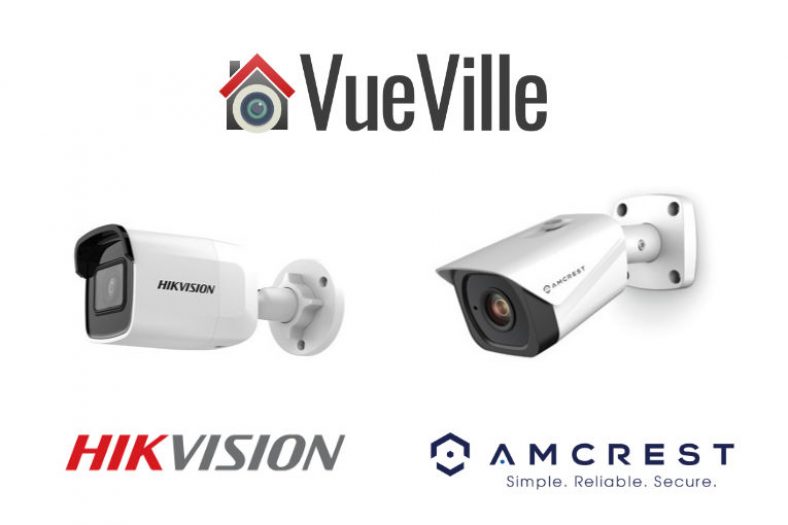
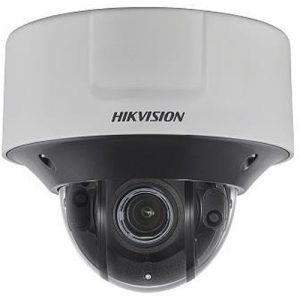
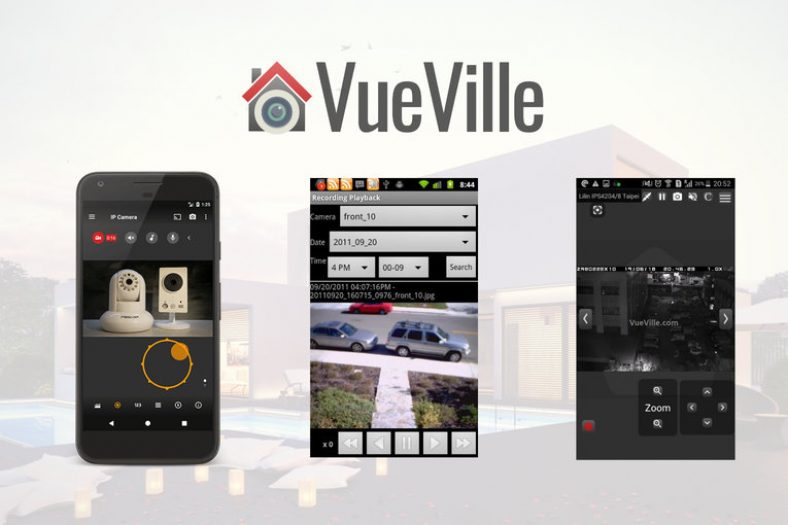
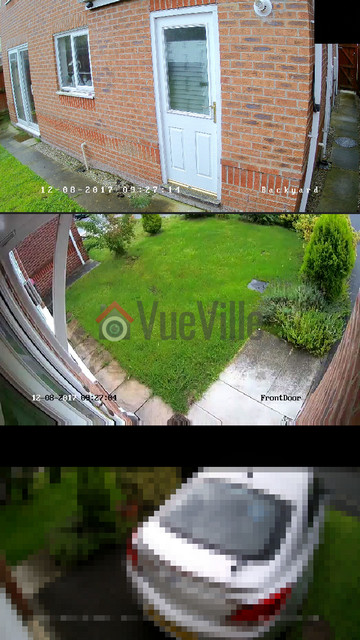
How do the more budget oriented Amcrest IP cameras compare to the more expensive Hikvision models? This is something I have been wondering about for some time now. From the emails I get, I am not the only one! So in this post, let’s take a detailed look at Hikvision vs Amcrest.
We have looked at Hikvision vs. Dahua in the past, and we found that comparable models from the two companies are very close to each other in both features and performance.
A quick note: This article may contain affiliate links. If you click on one of these links and then purchase something, we may receive a fee. This does not cost you anything extra. Also note that Hikvision and Dahua do not consider certain platforms including Amazon as an authorized seller platform. So if you need warranty support please purchase from authorized resellers of Hikvision and Dahua products in your country.
Hikvision vs. Amcrest – the Stories behind the Brands
Hikvision
You’re probably no stranger to Hikvision if you have been dabbling with DIY security cameras for some time. Hikvision is a surveillance equipment manufacturer based in Hangzhou China. They primarily cater to professional installers and are not really interested in retailing to the general public. But still they made a splash in the DIY space because of their affordable DIY IP cameras with powerful features. Like 3MP sensors which were unheard of in mainstream IP cameras in 2014 when I bought my first IP camera, the Hikvision DS-2CD2032-I.
A few years ago, they launched their retail brand EZVIZ. Confusingly, EZVIZ used to be the name of their cloud app as well. Anyway the EZVIZ models are dumbed down versions of the Hikvision cameras and are not worth spending any money on. That’s why I am focusing on the main Hikvision brand.
The biggest concern I have with Hikvision is not so much about their cameras, but who owns the company. The Chinese government owns at least a partial stake in Hikvision. This creates a few ethical and moral quandaries that I won’t go into here – you know what I’m talking about.
If you live in the USA, there’s one more reason to avoid Hikvision cameras – the US government has recently banned the sale and import of new Hikvision products into the USA unless certain conditions are met. They are still being sold by their authorized retail seller BH Photo though. Of course, you can always get them from AliExpress as most of us have always done.
From a technical standpoint, you should treat any security camera the same way – with maximum suspicion that they may be ‘dialing home’ to their manufacturer’s own servers and leaking your data. So lock them down using Virtual LANs (VLAN) and strict firewall rules like I have in my DIY home security camera system.
Amcrest
Foscam US re-branded themselves as Amcrest Technologies in early 2016. Foscam US (Foscam Digital Technologies) used to be an independent reseller for the Chinese manufacturer/supplier Foscam Shenzhen. However in 2016, the Chinese supplier allegedly started undercutting Foscam US. Foscam US says they had no choice but to cut all ties with Foscam Shenzhen and go it alone as Amcrest Technologies.
Foscam security cameras never had a great reputation and once Amcrest launched their own products, they have quickly overtaken the original Foscam brand both in quality, reliability, support service levels, and reputation.
8MP 4K IP Camera Duel – Hikvision DS-2CD2085G1-I vs. Amcrest IP8M-T2669EW-AI
In 2025, everybody’s selling 8MP IP cameras. 4K resolution is the buzzword and 8MP is what you need to get 4K video.
I have picked two compelling options from the two companies and pitted them against each other. I would normally compare the DS-2CD2083G0-I which is the cheapest Hikvision 8MP bullet you can get. However as a consumer you will probably be looking at the more powerful Hikvision DS-2CD2085G1-I which is priced only a bit more than the DS-2CD2083G0-I. It would be remiss of me to steer you to the DS-2CD2083G0-I when the more capable DS-2CD2085G1-I is available at a similar price.
So as you peruse the rest of this comparison, please bear in mind that the Hikvision DS-2CD2085G1-I is the best Hikvision 4K camera to compare to the best Amcrest 4K camera, the IP8M-T2669EW-AI.
Hardware features – Hikvision vs. Amcrest
The Hikvision I have selected is from the Darkfighter series. These are ultra low-light camera that can produce night-time colour video down to 0.008 lux. They can also provide great black and white video together with IR. Interestingly, Hikvision doesn’t claim that this camera has ColorVu technology but which does the same thing effectively.
Nor does this camera have the AcuSense feature which reduces false alarms by ignoring birds, animals, lights and movement of trees. For these features you need to step up to a more premium line of Hikvision cameras.
The Hikvision has a larger sensor (1/2″) than the Amcrest camera (1/2.8″). But as we shall see below they are closer in performance than this spec suggests.
Amcrest cameras have historically been rebranded Dahua cameras, and so shared most of the same features. Dahua has a highly acclaimed low-light technology called Starlight. The highest spec of Starlight also has full color night vision. Until last year, Amcrest cameras didn’t get Starlight at all. But now the IP8M-T2669EW-AI sports the Starlight sensor and can match the Hikvision in low-light colour vision. Even though Amcrest doesn’t market this camera as a color night vision model.
Both the Hikvision & Amcrest have true 120dB Wide Dynamic Range (WDR) to help improve video quality in high glare situations.
The cameras are both made from metal and have the same level of ingress protection (IP67). I am happy to see Hikvision have embraced IP67, they have always gone for IP66 for their outdoor IP cameras. But Dahua has always been using IP67. So Amcrest also gets the IP67 rating.
Neither have vandal protection (IK10), more expensive Hikvision bullets do have it these days.
The Amcrest does have a built-in microphone, but Hikvision doesn’t.
Winner: Amcrest
Software features – Hikvision vs. Amcrest
The three most important software features that I look for are ONVIF support, the built-in NVR feature, and the advanced motion detection features that help reduce false alerts. Why because if an IP camera has ONVIF and RTSP features, you can use it as a standalone IP camera or easily integrate it into a Pro-DIY type DIY NVR system like mine.
Both Hikvision and Amcrest support ONVIF, and RTSP on all their IP cameras.
ONVIF ensures that your camera will work with standards-compliant equipment from 3rd party manufacturers. This is why you can add a Hikvision or Amcrest camera to your ONVIF-compatible NVR or DIY NAS NVR and integrate it into my smart home automation system.
RTSP allows even non-ONVIF equipment (such as software) to access the security camera’s video stream. Examples are video players like the popular VLC player or [easyazon_link identifier=”B004VD3YIM” locale=”US” tag=”vueville.com-eaz-20″]tinyCAM Monitor Pro[/easyazon_link] on Android.
Motion Detection ability
Both Amcrest and Hikvision have advanced motion detection features like line crossing, intrusion detection. Hikvision further supports unattended baggage detection, and object removal detection.
I can’t emphasize enough the importance of these advanced motion detection methods in reducing false motion alerts.
But Amcrest has something the Hikvision DS-2CD2085G1-I doesn’t have – person and vehicle detection. This is a recent addition to Amcrest cameras and not all models have it yet, but the IP8M-T2669EW-AI does as indicated by the AI in the model name.
So Amcrest gets the slight edge here if you are going to use it as a standalone IP camera without an NVR connected, or as part of a DIY NAS NVR system.
Winner: Amcrest
Mobile app
There’s no contest here, the Amcrest mobile app is miles ahead of the IVMS suite of Hikvision mobile apps.
Winner: Amcrest
Warranty – Hikvision vs. Amcrest
Hikvision products come with a limited 3-Year Warranty if purchased from authorized dealers. Please note you may not get the warranty if you purchase from other retailers such as Amazon.
Amcrest provides only a 1 year warranty.
So Hikvision wins easily here.
Detailed Comparison Table
Here’s a summary of the full review in a nice and easy table:
[table id=60 responsive=”scroll” /]
Verdict – Hikvision vs. Amcrest
Thanks to the smart detection features such as person and vehicle detection, Amcrest gains the edge over Hikvision in my opinion. The ongoing governmental sanctions against Hikvision also mean its probably a better idea to avoid Hikvision products.
Also check out the other recommendations on our best outdoor IP cameras list for more interesting cameras reviewed from a DIY perspective.
Where to buy
Amcrest IP8M-T2669EW-AI at [easyazon_link identifier=”B08CWGJY37″ locale=”US” tag=”vueville.com-eaz-20″]local Amazon website.[/easyazon_link]
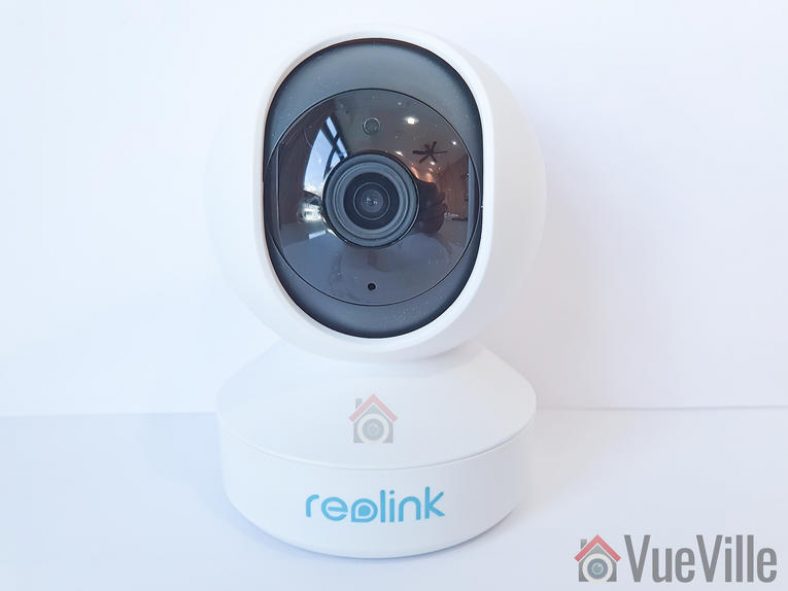
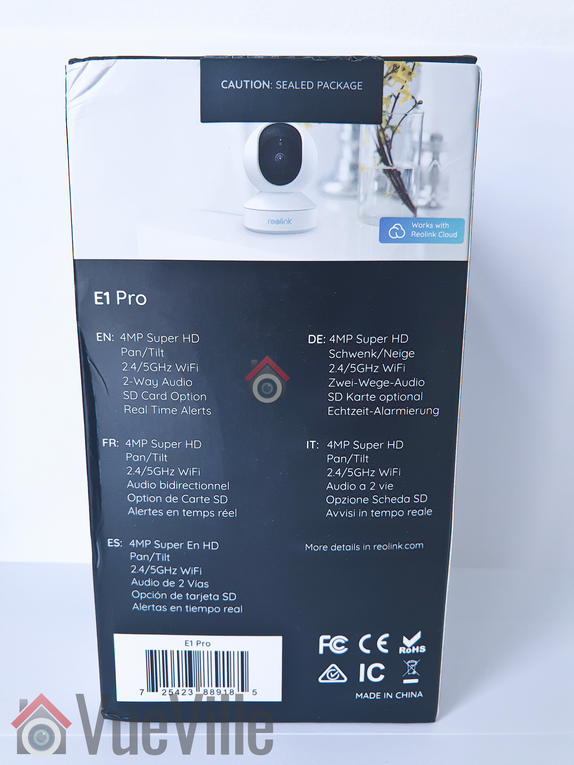
A few years ago we reviewed the Reolink C1 Pro, a 4 Megapixel wireless pan-tilt indoor security camera. We loved it so much that it became our main nursery baby monitor. Now Reolink has launched another 4MP Pan-Tilt, the E1 Pro which is an even more affordable option than the C1 Pro. What’s more, it supports person and pet detection and even auto-tracking!
So how does the E1 Pro perform, what features if any have been sacrificed and ultimately should you buy it? To find out, we put a review sample that Reolink provided through its paces in this hands-on review.
A quick note: As an Amazon Associate I earn from qualifying purchases. This post contains affiliate link(s). An affiliate link means I may earn advertising or referral fees if you make a purchase through my link, at no extra cost to you.
Specifications
[table id=61 responsive=scroll /]
Unboxing
What’s in the box
Reolink E1 Pro PT Indoor Wireless Security Camera
DC 5V wall adaptor
Power cable
Wall mounting bracket
Quick Start guide
What’s next booklet
Drilling templates
Reolink surveillance notification sticker
Screws and rawl plugs
Design & Features
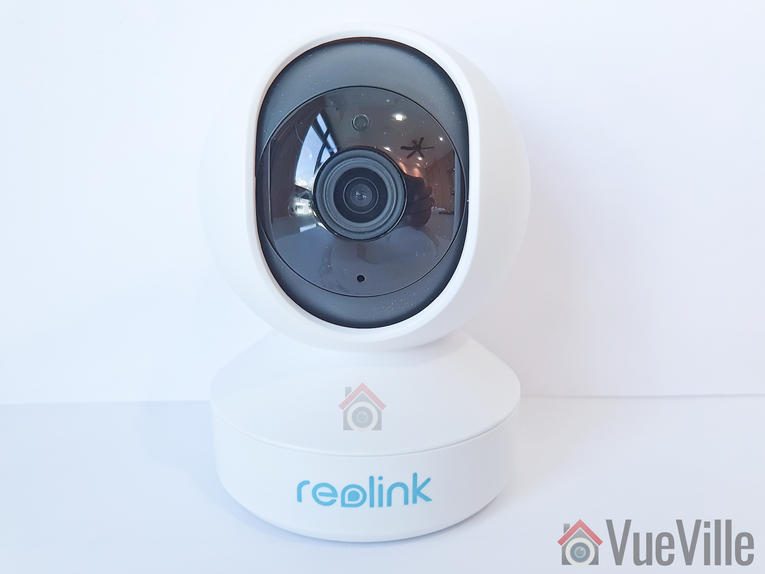
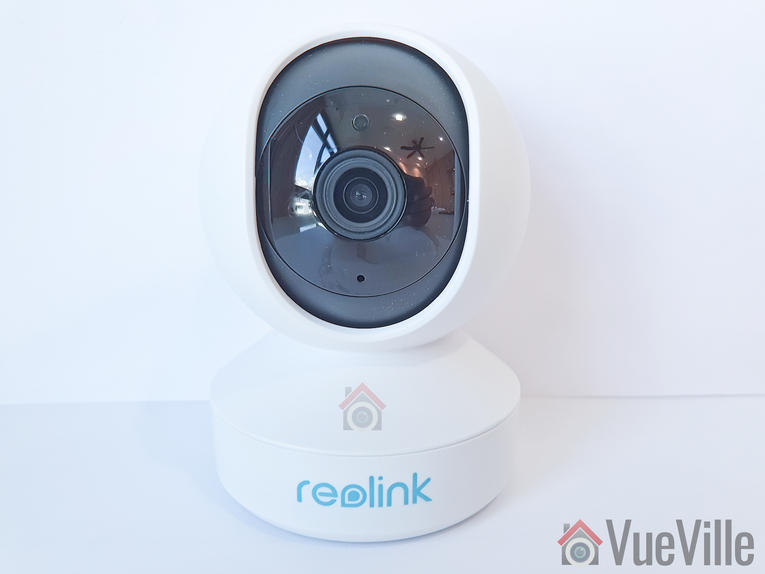
The E1 Pro is different from any other Reolink camera I have seen. It is very compact and weighs just 200 grams.
The camera can be divided into 3 parts – the black lens housing, the white tennis ball shaped body, and the white base. The tennis ball design of the body which surrounds the black lens housing is a neat design. Overall, the high-quality fit and finish of the camera exudes a premium aura that belies its budget price.
So how does this Pan-Tilt camera work? When panning, the entire upper body revolves around the base. When tilting, only the black lens housing rotates up or down.
The black lens housing has a matte design and is super smooth to the touch. The daylight sensor is integrated into the ring-type 8 Infrared LEDs concealed smartly around the lens. If you look carefully you can see the red tinge of the Infrared LEDs under the darkened glass surrounding the lens.
The built-in microphone is placed just under the lens. The SD card slot and the reset button are also placed here, which is actually a genius idea. When the camera is in its default position of looking straight ahead, the SD card slot and the reset button are totally concealed! Tilt the lens up all the way using the Reolink mobile app or PC Client software and you can access the slot and the reset button.
The left and right sides of the body are bare but you will find the built-in speaker on the back of the lens housing.
The base of the E1 Pro has just the AC power input. Unusually this is not a microUSB design.
Update: Reolink has recently added an Ethernet port to the E1 camera lineup, and so the E1 Pro can also be used as a wired camera.
Flip the camera over and you will find the slot for fitting the wall bracket and a sticker with the QR code for setting up the camera in the Reolink mobile app.
The dual-band Wi-Fi antennae are prominent by their absence. Yes, the antennae are built-in but in my testing this doesn’t seem to affect range noticeably. Just like the C2 Pro, the 5 Ghz Wi-Fi is a great feature to have as most of the competitors are still sporting just 2.4 GHz Wi-Fi. The higher bandwidth capacity of the 5 Ghz band comes with a significant range disadvantage though.
All in all, the camera feels light yet solid in construction. The contrasting colours and the matte finish of the black lens housing really makes the E1 Pro look and feel far more expensive than it really is.
Installation & Setup
The Reolink E1 Pro comes with a very good quick start guide which is a double-sided glossy booklet, just like the other Reolink cameras I have reviewed. The general introduction section illustrates and labels the different parts of the camera such as the daylight sensor, the built-in mic, the speaker, the indicator LEDs and the various connections.
There is also a helpful camera connection guide for those who are new to security cameras. The setup is voice guided (just like the Reolink Argus) and can be done fully wireless. I would expect most people to use the camera’s Wi-Fi option rather than the Ethernet port, so that’s what I have also done in this review.
So you have two options for setting up the camera:
Setup using a smartphone or tablet using the Reolink app, or
Setup using a laptop and the Reolink Client software for PC
Reolink recommends the smartphone app method, so that’s what I did.
Install the Reolink mobile app. I had it already installed since I use the Reolink C2 Pro, C1 Pro and the Argus all of which I have reviewed in the past.
Power on the E1 Pro. You will hear a voice message ‘Please run the Reolink app and add the camera to set it up’.
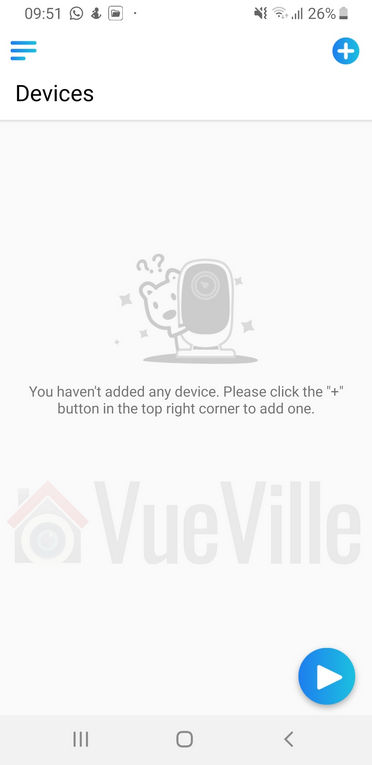
In the Reolink app, click the plus button at the top right to add the camera, and choose the ‘Connect to Wi-Fi option’.
I was not happy to see the app asking for location access, feel free to deny it – the setup will continue successfully anyway.
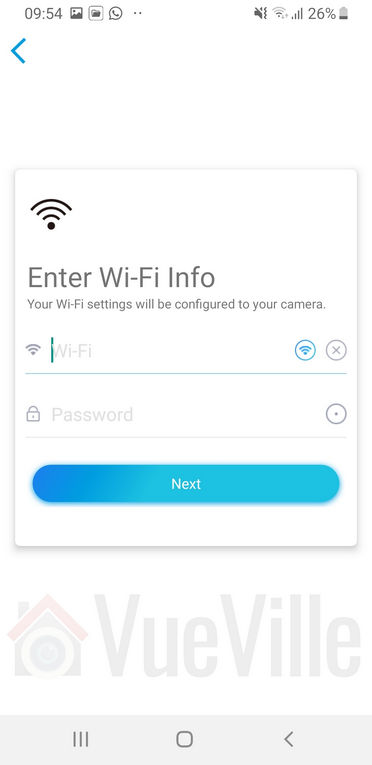
Enter your Wi-Fi info into the app. The app will then transfer it to the camera in the next step.
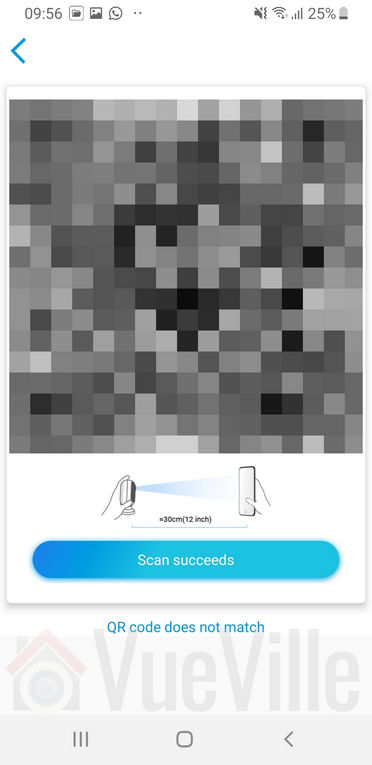
Scan the QR code on the bottom of the camera base.
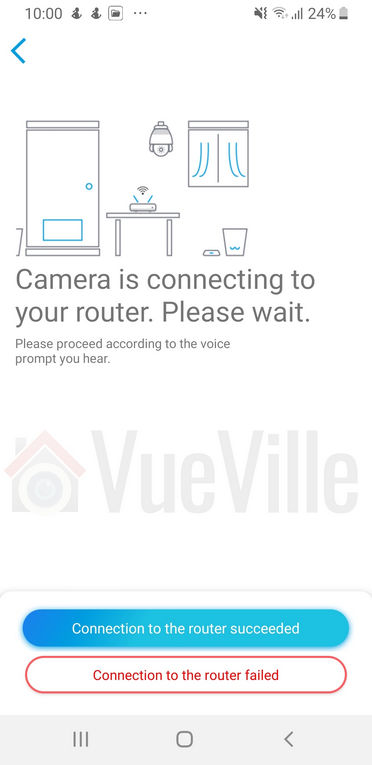
The camera will then attempt to connect to your Wi-Fi network.
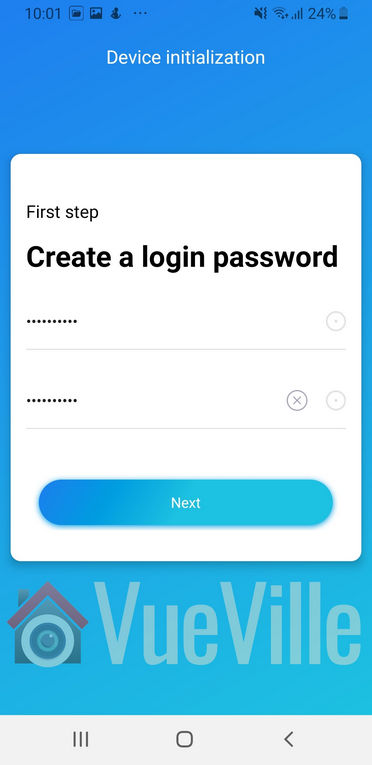
After the camera has initialized, create a login password to complete the setup process.
Configuring the E1 Pro
The only way of configuring the camera is using the Reolink mobile app. Unlike the C1 Pro, the E1 Pro does not have a built-in web server where you can access the advanced settings. In that respect it is more like the Reolink Argus. In the next section, I will cover the camera configuration also.
Using the Reolink mobile app
The Reolink mobile app has always been a reliable and well-designed app. I have never experienced the app crashing on my Samsung Galaxy S9.
As Reolink started introducing cameras such as the Argus without a built-in web server, it became essential for the app to be able to fully configure the camera. The E1 Pro leverages the app very well and the app allows you almost full control over the camera.
When you open the app after setting up the camera, you are greeted with the familiar camera selection list with a static preview image. What’s new in the app is the ability to group cameras together and apply Scenes or quick modes to them quickly – this is a great feature if you have multiple Reolink cameras but dont have an NVR. You can create custom scenes, say, ‘Arm alarm’ to instantly enable motion detection recording, push/email alerts, and audio buzzer alarms when you leave the home. Then when you return you can just activate a ‘Disarm alarm’ scene to deactivate all alarms/alerts.
Touching the camera preview image takes you to the Live-view screen of the E1 Pro. Here you can adjust the Pan-Tilt camera position, use the 2-way audio talk feature, record a clip or take a snapshot. There’s also a nifty audio buzzer button that will briefly sound the camera alarm buzzer. Its not very loud but should be enough to scare away an intruder!
The playback button at the bottom right is for accessing the built-in NVR feature of the E1 Pro. More on that later. Back in the app home page, you can touch the gear icon of the E1 Pro to access the camera settings.
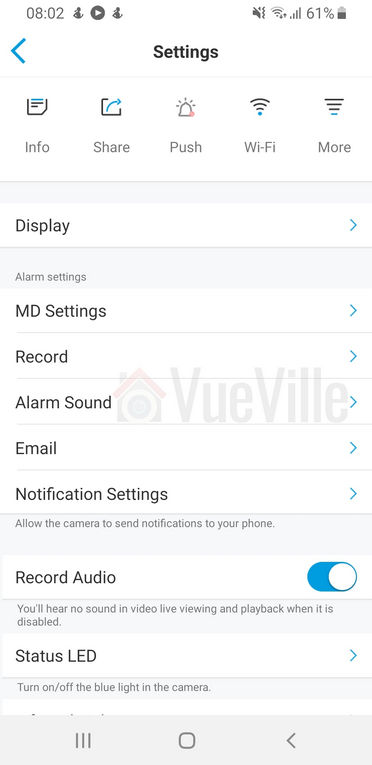
You can either activate/deactivate individual alert settings or use the Scenes feature mentioned earlier to control the camera behaviour. This is my favourite way of managing the alert settings of the E1 Pro.
Under Display, you can adjust the video stream settings – you can choose between 4MP, 3MP, 1080p and 720p for the main stream. 4MP is the default.
You can also perform user management here, such as setting up additional users for your family members’ smartphones.
The E1 Pro has the usual P2P and UID features but the app doesn’t give access to these settings. If you want to change these and other advanced settings such as port numbers, you can do it through the Reolink Client PC app.
Built-in NVR Feature
The built-in NVR feature of the E1 Pro allows you to record video clips without having to buy a separate NVR. What is this built-in NVR feature? Basically, pop in a microSD card and the camera can record motion detection triggered video clips or snapshots to the SD card.
This means that if you need only a single camera or two in your home , you don’t need to buy a separate NVR just to record video footage (although I strongly recommend it ). The camera can also push notifications to the Reolink app on your mobile phone, send email alerts with attached snapshots or video clips.
Adding a microSD card for motion detection recording
I inserted a microSD card into the SD card slot. I had to push the card all the way into the slot before it click-locked. I then formatted the card through the Reolink mobile app. The camera then automatically rebooted and the microSD card was ready for use.
You have several options to control the motion detection recording behaviour. First up is sensitivity, you can go for the default single setting or set up multiple settings for different times of the day.
You can also define the area that the camera should monitor for motion.
The two features above will go a long way in reducing false motion detection alerts.
Reviewing recorded footage
There are three ways to view the recorded footage – the Reolink mobile app, the Reolink Client PC software, and manually accessing the clips on the microSD card with a laptop.
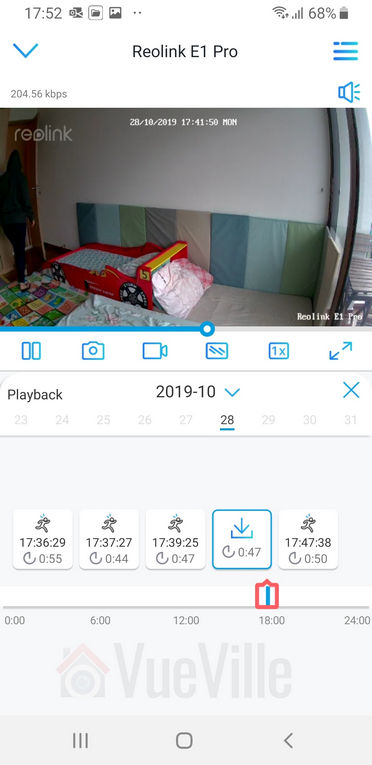
Using the mobile app, you can login any time from anywhere to review the footage through a timeline view. The mobile app also identifies each motion detection event so that you can just play those without having to scrub through the timeline.
At first I thought were only the sub-stream clips could be downloaded to the phone and not the main stream. But Reolink guided me to the picture quality icon – tap it and change it to 4MP and you can download the 4MP clips!
You can also do all of the above through the Reolink Client app or remove the SD card and take the video clips off it with a laptop.
Mobile Push Notifications
Use the Scenes feature to control when and how push notifications are delivered to your smartphone.
Remember that push notifications will not work outside your local network if you switch off P2P though.
Adding the Reolink to QNAP Surveillance Station
The E1 Pro supports both ONVIF and RTSP, so I was easily able to add it to my QNAP TS-253A’sSurveillance Station app. I first created an additional user for the NAS using the admin section of the camera app.
The ONVIF port is port 8000, the media port is 9000, RTSP is available at port 554 and RTMP at port 1935.
Performance
The E1 Pro has a 4MP sensor which can record at up to 2560 x 1440 resolution. The maximum bitrate of 4Mbps is lower than the usual 8Mbps of other Reolink cameras.
Let’s look at the default settings the Reolink E1 Pro comes with from the factory:
Main stream: 4MP @ 15fps and 3Mbps
Since these are the defaults, I ran my day and night tests at these settings.
Video quality
Video captured was sharp and detailed both during the day time and in total darkness, in line with my expectations for a 4 Megapixel IP camera.
Here are the motion detection triggered videos recorded at the default settings:
There was no blurring of the video and there were no dropped frames.
Motion detection
The E1 Pro is able to do both pre-recording and post-recording. This means the camera is able to record not just what happens after motion was triggered but 5 seconds before the trigger as well. This is a great feature and something that I always look for in a security camera.
The post-record feature lets you decide how many seconds the camera should record after the last motion trigger. The default is 15 seconds.
Night vision
The 8 InfraRed LEDs placed around the lens in a ring pattern are reasonably powerful and can light up a decent sized room with no trouble.
There are no settings to control the brightness of the LEDs and there are no advanced features to dynamically control the infrared light output.
Audio quality
Just like the other Reolink indoor security cameras, the E1 Pro supports 2-way audio. Usually the implementation in most manufacturers’ native apps mutes the audio when you activate the microphone. In other words they have half-duplex audio, not full-duplex. Ideally to use the camera as an intercom, you need 2-way full duplex audio.
Interestingly Reolink has not claimed full duplex audio, but the Reolink app doesn’t mute the incoming audio when you press the microphone button. You can continue to hear what the person at the other end is saying when you are speaking. So the E1 Pro actually supports full duplex audio.
So how well does it work in practice? The audio quality is great and the dual speakers do a great job in reproducing audio. But there is a noticeable lag, however slight, in audio playback and this makes the full duplex capability less useful. We found ourselves using the Reolink E1 Pro more like a walkie-talkie just like the Amcrest ProHD cameras.
PT performance
If you are planning to use the E1 Pro as a baby monitor with 2-way audio, you will be interested in how much noise it makes while panning and zooming.
I was pleased to find that the E1 Pro just like the C1 Pro hardly makes a sound while starting up, panning or tilting. So it makes for a great baby monitor.
A long-standing issue I have seen in Reolink cameras is that the motion detection stays active even when you use the Pan-Tilt controls. This means the camera records a motion detection clip each time you use the PTZ controls. The E1 Pro is no different here and exhibits the same behaviour.
Wireless performance
The E1 Pro (just like the C2 Pro) boasts 2T2R MIMO antennae for improved wireless performance. So I moved the camera to the farthest point in my house to see how the Wi-Fi performed. Over both 2.4GHz and 5 GHz, the E1 Pro was stable and performed just as if it was connected over Ethernet.
Mobile app push notifications
So what should you be looking for when it comes to push notifications? The speed and reliability of the push notifications reaching you. You want the camera to send you push notifications immediately after it detects motion.
Especially if you have configured email alerts, SD card recording at 4 Megapixel recording and push notifications, inferior cameras may struggle with the workload.
The E1 Pro performed like a champ. Inside my local network I got push notifications on my phone instantaneously and on remote networks there was a delay of just 1 second which is very impressive. The success rate of receiving the push notifications over multiple motion triggers was a solid 100%.
Verdict
The E1 Pro is a stylish yet budget-friendly DIY security camera that simply gets the job done. With its easy voice-guided setup, smart person detection, on-board microSD storage, built-in NVR feature, full duplex 2-way audio, push alerts and dual-band WiFi, the E1 Pro offers fantastic bang for the buck.
DIY enthusiasts will appreciate the availability of RTSP streams & ONVIF compliance which allows the E1 Pro to work with a DIY NAS NVR. Kudos to Reolink for supporting this feature even in this entry-level camera. But they may not be too happy about no web browser access and the max 4Mbps bitrate. Still that’s a small price to pay for this much value.
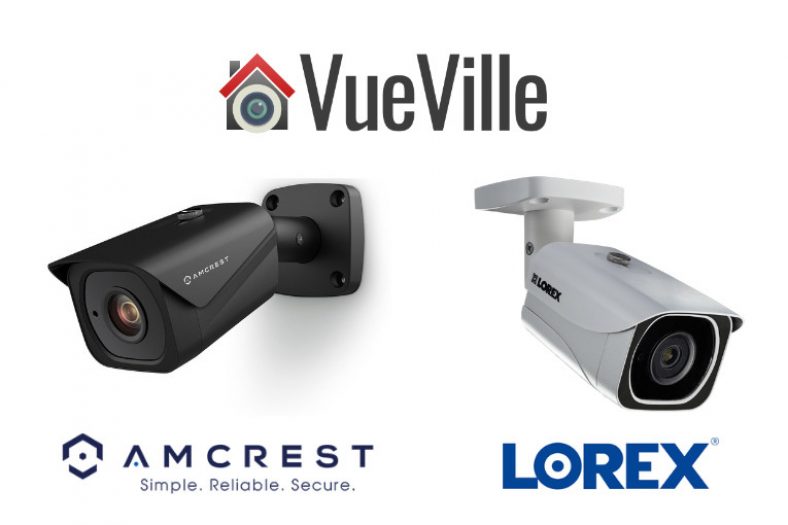
Having just recently compared Reolink and Lorex, let’s now throw in another popular DIY IP camera brand into the mix and compare them – Amcrest vs Lorex.
Reolink and Amcrest are similar in the type of products they market – good quality standalone IP cameras and NVRs that are ONVIF compliant and very affordable.
Lorex on the other hand has focused on selling NVR kits rather than IP cameras capable of standalone operation.
A quick note: As an Amazon Associate I earn from qualifying purchases. This post contains affiliate link(s). An affiliate link means I may earn advertising or referral fees if you make a purchase through my link, at no extra cost to you.
Amcrest vs. Lorex – the Stories behind the Brands
Amcrest
Foscam US re-branded themselves as Amcrest Technologies in early 2016. Foscam US (Foscam Digital Technologies) used to be an independent distributor for the Chinese manufacturer/supplie Foscam Shenzhen. However in 2016, the Chinese supplier allegedly started undercutting Foscam US. Foscam US says they had no choice but to cut all ties with Foscam Shenzhen and go it alone as Amcrest Technologies.
Foscam security cameras never had a great reputation and once Amcrest launched their own products, they have quickly overtaken Foscam both in quality, reliability, support service levels, and reputation. They are still around though.
Amcrest mostly re-brands Dahua cameras.
Lorex
Lorex was founded in 1993 and has head offices in Markham, Ontario, Canada and in Linthicum, Maryland, USA. They have product warehouses in Markham, Indiana and California.
But first let’s start with the company FLIR, better known as the high-end camera manufacturer who revolutionized thermal imaging for the military and industrial markets. They acquired Lorex in 2012 for around $60 million seeking to lower the cost of thermal imaging and open it up to the retail market.
So for the next 6 years they tried to penetrate the DIY and SMB markets. During this period, their main OEM supplier was Dahua. In February 2018, however, FLIR exited the DIY security camera space by selling Lorex to Dahua. They currently operate as a subsidiary of Dahua. So think of Lorex as a Dahua brand.
8MP 4K IP Camera Duel – Amcrest (IP8M-2496EB) and Lorex LNB8111BW
So Amcrest rebrands Dahua and Lorex is Dahua. So this is looking more like Dahua vs. Dahua isn’t it? Well Amcrest and Lorex used to target different DIY consumers, but that gap is narrowing as we shall see.
I have opted to compare the most popular 8MP models from Amcrest (IP8M-2496EB) and Lorex (LNB8111BW). These are 4K cameras.
The Biggest Difference between Amcrest and Lorex IP Cameras
If you thought the answer is ONVIF support, you would have been right…. last year.
But all Lorex cameras now support ONVIF, so you can use them with any ONVIF-compatible NVR. So you can add them to a non-Lorex NVR or to a DIY NAS NVR system.
Amcrest has always supported ONVIF.
So what is the biggest difference between Amcrest and Lorex? Amcrest IP cameras are capable of standalone independent operation without an NVR, wheras Lorex IP cameras cannot.
Amcrest has always made cameras that are capable of standalone operation. This means you do not need an NVR to make the camera work. That’s right they have the built-in NVR functionality just like Hikvision, Dahua and Reolink do. They can also detect motion, record video clips to a microSD card, send email and push notifications, even upload to an FTP server.
Lorex cameras cannot do any of this. Without an NVR or another device (like a NAS) to store the video, there’s no point in buying one. Now if you are going to use an NVR anyway, this is not an issue for you. Also since they have ONVIF support, they should theoretically work with any ONVIF-compliant NVR. Not just Lorex ones.
Hardware features
Both the Amcrest and Lorex cameras have a nice large 1/2.5″ progressive scan CMOS sensor. This is even better than Reolink’s which has a slightly smaller 1/2.7″ sensor. The Lorex uses a Sony Exmor R CMOS sensor whereas the Amcrest uses a Sony Starvis CMOS sensor.
The size of the sensor has a huge bearing on the low light ability of a camera. The larger the sensor, the greater its ability to gather light and so do well in low light conditions. But as you cram in more and more pixels into the same size sensor, they get smaller and smaller, which adds noise. Noise is the bane of low light video and reduces the detail that you can get out of your video. So while security camera manufacturers have pushed pixel count from 2MP to 5MP and beyond, most have not really increased the sensor size.
The Amcrest has a substantially wider viewing angle of 112° vs. the Lorex’s 88° angle of view.
On to low light performance. While most IP cameras are good in daylight, night-time performance is what separates the men from the boys. The Lorex sports colour night vision – this is a very interesting feature and does set the Lorex brand apart. However be aware that the camera will switch back to black & white IR night vision below 1 lux to ‘ensure optimal low-light image quality’ as Lorex puts it.
The Amcrest camera has only standard black and white infrared night vision. But the minimum illumination required is impressive, 0.06Lux without IR and 0Lux with IR on. The IR range is also 40 feet more than that of the Lorex.
Neither camera has special features such as PIR motion sensors, audio, or alarm connections. But the Amcrest does have a microSD card slot and the built-in NVR feature.
Software features
When it comes to video encoding, both cameras support the highly desirable H.265 option for lowering bandwidth usage and generating smaller video file sizes.
Next up is WDR or Wide Dynamic Range. This is a feature that enhances the level of detail an IP camera can pick out in shadows. Amcrest supports 120dB WDR. Lorex doesn’t have WDR, but instead claims High Dynamic Range (HDR) support. While I doubt they are comparable, it is better than nothing.
The three software features that make a great IP camera are ONVIF/RTSP support, built-in NVR feature, and the advanced motion detection features that help reduce false alerts.
Here, the main differences between the Amcrest and the Lorex are that:
Amcrest has the built-in NVR feature, as it is capable of standalone operation, but Lorex doesn’t.
Both Amcrest and Lorex have only basic motion detection but the Lorex can work only when it’s connected to an NVR.
Motion Detection ability
Neither camera has advanced motion detection methods which go a long way in reducing reducing false motion alerts.
Warranty
Lorex has a 2 year warranty as standard, but can be extended to 3 years or 5 years for an extra fee.
Amcrest has only a 1 year warranty as standard, but promises lifetime support.
Here’s a summary of all the differences in a nice and easy table:
[table id=59 responsive=”scroll” /]
Verdict
Lorex cameras are basically Dahuas that are locked down. You can still add them to any NVR that supports ONVIF. It has all the basic hardware features that you would expect and has colour night vision and HDR also. But they still are not as capable as Amcrest cameras. Lorex cameras are not an option if you want a standalone IP camera that can operate without an NVR.
So I would recommend Amcrest instead. Now if the Amcrest doesn’t meet your specific requirements, just opt for a Dahua IP camera. Simples.
4K cameras may be all the hype right now, but what if they just don’t cut it for your specific needs? Want to step up to the best 12 MP CCTV cameras on the market? We got you covered.
We rounded up the best 12MP IP cameras on the market that offer both stellar daytime detail and outstanding night time performance with no compromise on features.
Of course, the price band these premium IP cameras occupy is a step above the 4K cameras but that’s to be expected.
The Best 12 Megapixel Security Cameras
[wpsm_toplist]
Hikvision DS-2CD4AC5F-IZH – Outdoor Bullet with Motorized Zoom, Audio and Heater
What list of high-end IP cameras would be complete without Hikvision on the list? Let’s start with the Hikvision DS-2CD4AC5F-IZH. Just like the Dahua, this IP camera also sports a 1/1.7″ CMOS sensor. The lens is a more standard 2.8 – 12 mm motorized varifocal with f/1.4. The lens also has the Smart Focus with auto-iris feature. The viewing angle ranges from 31.8° to 93.6°.
H.264 H.264+ and H.265 encoding are supported. It can only do 15 fps at 12MP resolution, which is a slight letdown.
Night vision range of 50 metres is provided by the onboard EXIR style IR LEDs.
Compared to the Dahua above, the Hikvision also supports line crossing (tripwire), intrusion detection, and abandoned/missing object, face detection, people counting, and a heat map feature.
Local storage of images and motion detection clips is supported with an SD card slot that takes up to 128 GB cards. For cameras with such high pixel counts, the SD card is more suited as a fail-over video recording destination in case of network outage.
On the connectivity front, IEEE 802.3af PoE is present. The -S in the model name indicates the 1x audio in and outs, and 1x alarm in / 1x out ports.
A standout feature is the built-in heater for starting the camera in low temperature operation. This is indicated by the -H in the model name.
On the list of downsides, I would mention the lack of 120dB WDR, the 15 fps frame rate max for 12MP recording and lack of 2-way full-duplex audio.
Dahua is a great security camera brand so let’s see if they have an answer to the Hikvision above. The IP camera that I have picked is the Dahua NK8BB7Z. This IP camera also uses a very large and highly sensitive 1/1.7″ Sony Starvis sensor with 12MP resolution. It also has a motorized zoom range of 4.1 mm to 16.4 mm. An auto iris feature based on the Hall effect sensor is also provided.
The camera can encode 4000×3000 resolution at 20fps which is better than the comparable Hikvision models. Both H.264 and H.265 encoding are supported. There is also a feature called Smart H.265+ whereby the camera uses a scene-adaptive strategy to reduce bitrate and storage requirements qithout compromising quality.
The f-stop is F1.53 at the wide end. The viewing angle ranges from 35° to 85° at 12MP resolution.
One feature frequently missing from high MP cameras is an on-board IR illuminator. Fear not, this Dahua has 4 EXIR LEDs giving it a stellar night vision range of 50m (164 feet).
I always rave about security cameras with advanced motion detection ability because they can drastically reduce false alerts. Like all top-end Dahua IP cameras, this camera also supports line crossing (tripwire), intrusion detection, and abandoned/missing object. On top of that, it also has face detection, people counting, and a heat map feature.
Local storage of images and motion detection clips is supported with an SD card slot that takes up to 128 GB cards. For cameras with such high pixel counts, the SD card is more suited as a fail-over video recording destination in case of network outage.
On the connectivity front, IEEE 802.3af PoE is present, as is 1x audio in and outs. 2x alarm in / 1x out are also provided.
Just like the Hikvision model, there’s a built-in heater for cold start situations.
The downsides in this model are lack of WDR, no audio detection features and the 2-way audio is only half-duplex (like a walkie-talkie).
Hikvision DS-2CD55C5G0-IZHS – Outdoor Dome with Zoom & Heater
If you prefer the vandal resistance of a dome form factor, this Hikvision DS-2CD41C5F-IZ has you covered. This dome has most of the same features as the Hikvision bullet we saw earlier. So I will focus on the differences. The 1/1.7” Progressive Scan CMOS is not the Starvis type. Still it can do a minimum of 0.008 Lux when zoomed out and with IR, it can work in complete darkness of 0 Lux.
The semi-manual varifocal lens goes from 2.8-12mm and has viewing angle ranges from 36.1° to 101°.
H.264, H.264+, H.265 and H.265+ encoding are supported. It can do 20 fps at 12MP resolution, which is very good.
Night vision range of 30 metres is provided by the on-board EXIR style 850nm IR LEDs.
Local storage of images and motion detection clips is supported with an SD card slot that takes up to 256 GB cards, but edge recording is not available.
On the connectivity front, IEEE 802.3af PoE is present. The -S in the model name indicates the 1x audio in and outs, and 1x alarm in / 1x out ports.
The -H in the model name means there is a built-in heater for cold start applications
On the list of downsides, I would mention the lack of 120dB WDR and lack of 2-way full-duplex audio.
Dahua NK8BL7Z – Outdoor Dome with Motorized Zoom & Heater
So let’s look at this alternative to the Hikvision dome above. The Dahua NK8BL7Z also has a similarly large and highly sensitive 1/1.7″ Sony Starvis sensor with 12MP resolution. It also has a motorized zoom range of 4.1 mm to 16.4 mm.
Both H.264 and H.265 encoding are supported. It can also do 20 fps at 12MP resolution and 30fps at 4K (8MP) resolution). The f-stop is F1.53 at the wide end. The viewing angle ranges from 35° to 105° at 12MP resolution. The auto iris is motorized and is the Hall effect type.
This Dahua dome has 3 EXIR LEDs giving it very good night vision range of 50m or 164 feet.
Like all top-end Dahua IP cameras, this camera also supports line crossing (tripwire), intrusion detection, and abandoned/missing object. On top of that, it also has face detection, people counting, and a heat map feature.
Local storage of images and motion detection clips is supported with an SD card slot that takes up to 128 GB cards. For cameras with such high pixel counts, the SD card is more suited as a fail-over video recording destination in case of network outage.
On the connectivity front, IEEE 802.3at PoE+ is present, as are 1x audio in/out and 1x alarm in/out connections.
On the list of downsides, I would mention the lack of 120dB WDR, lack of 2-way full-duplex audio and audio detection alert events.
Vivotek MS8391-EV Outdoor Panoramic Security Camera
Vivotek is a high-end security camera manufacturer that typically caters to the commercial integrator market. But they do sell retail and you can pick up one of their amazing cameras pretty easily.
The MS8391-EV is a unique outdoor vandal-resistant panoramic camera that can do a resolution of 7552 x 1416. The panoramic term refers to its amazing 180 degree field-of-view. It does this by putting together the images from the 4 discrete 3MP sensors.
Each sensor has a 6mm lens with f/1.6 aperture. It has night vision through the 4 Smart IR LEDs that are built-in. The range is a good 98 feet.
Enhanced Wide Dynamic Range (WDR) is available to avoid areas such as shadows getting under-exposed. 2-way audio is available and as with most Vivotek cameras, this is the full-duplex variety. No walkit-talkie business here!
A microSD/SDHC/SDXC slot is available for edge recording. The only downside is the maximum frame rate of 7 fps at 12MP resolution. Smart stream technology is included to optimise bandwidth usage.
Power input is via either 24 VAC or 802.3at PoE connection.
httpv://www.youtube.com/watch?v=H_rXBbJvVpQ
[wpsm_divider top=”20px” bottom=”20px” style=”clear”]
The IPC-HFW81230E-ZE is an affordable performer from the Dahua IP camera stables. It sports a very large and highly sensitive 1/1.7″ Starvis sensor with 12MP resolution. It also has a motorized zoom range of 4.1 mm to 16.4 mm. An auto iris feature based on the Hall effect sensor is also provided.
Both H.264 and H.265 encoding are supported. It can also do 20 fps at 12MP resolution. The f-stop is F1.53 at the wide end. The viewing angle ranges from 35° to 105° at 12MP resolution.
One feature frequently missing from high MP cameras is an on-board IR illuminator. Fear not, this Dahua has 4 EXIR LEDs giving it a stellar night vision range of 50m or 164 feet.
I love security cameras with advanced motion detection ability. Like all top-end Dahua IP cameras, this camera also supports line crossing (tripwire), intrusion detection, and abandoned/missing object. On top of that, it also has face detection, people counting, and a heat map feature.
Local storage of images and motion detection clips is supported with an SD card slot that takes up to 128 GB cards. For cameras with such high pixel counts, the SD card is more suited as a fail-over video recording destination in case of network outage.
On the connectivity front, IEEE 802.3af PoE is present, as is 1x audio in and outs. 2x alarm in / 1x out are also provided.
Smart home compatibility: ONVIF Profile S & G, API
[/wpsm_column]
[easyazon_link identifier=”B07SFLMZZX” locale=”US” tag=”vueville.com-eaz-20″]Check price on Amazon[/easyazon_link]
What to look for in a 12 Megapixel Security Camera
At the high-end of the security camera market populated by the 12 Megapixel IP cameras, there are features that you just wouldn’t see elsewhere.
So a slightly different set of criteria need to be set before you select your 12MP camera:
Indoor or Outdoor – Outdoor cameras should have at least an IP66 rating for weather protection
Wired connections – At 12 Megapixel resolution of 4000×3000, you have to use a wired connection. Wi-Fi simply doesn’t have the bandwidth required to carry that much data. 802.3at PoE (also called Poe+) is fine but an SFP fibre-optic slot is even better due to its ability to cover long distances.
Local storage for Edge Recording – As a failover mechanism in case of link failure, an SD card can be a life-saver.
Smart motion detection methods such as line crossing, intrusion detection, face detection and even heat maps should come as standard. Less common is audio event detection.
If 2-way audio is important to you, look for full-duplex support as opposed to half-duplex. Otherwise you will be having an 80s style walkie-talkie conversation through your very expensive 12MP IP camera!
Smart home compatibility – Make sure the camera has ONVIF support for inter-operability with other brands and hardware
Conclusion
The 12 Megapixel CCTV cameras that we have reviewed above are the cream of the crop when it comes to high-resolution security cameras. The added features such as heaters and optical zoom allow you to cover large areas without giving up video quality.
If you are just stepping into the world of home security cameras, the first brands you will come across are probably Lorex and Swann.
These two brands are commonly found in big box stores across the country and sport attractive price tags compared to the likes of Hikvision and Dahua IP cameras. They also have a strong online presence.
So should you spend your had earned cash on one of these budget brands? What, if anything, are you sacrificing for that super budget-friendly price? Let’s find out.
A quick note: As an Amazon Associate I earn from qualifying purchases. This post contains affiliate link(s). An affiliate link means I may earn advertising or referral fees if you make a purchase through my link, at no extra cost to you.
Lorex vs. Swann – the Stories behind the Brands
Lorex (now owned by Dahua)
Lorex was founded in 1993 and has head offices in Markham, Ontario, Canada and in Linthicum, Maryland, USA. They have product warehouses in Markham, Indiana and California.
But first let’s start with the company FLIR, better known as the high-end camera manufacturer who revolutionized thermal imaging for the military and industrial markets. They acquired Lorex in 2012 for around $60 million seeking to lower the cost of thermal imaging and open it up to the retail market.
So for the next 6 years they tried to penetrate the DIY and SMB markets. During this period, their main OEM supplier was Dahua. In February 2018, however, FLIR exited the DIY security camera space by selling Lorex to Dahua. They currently operate as a subsidiary of Dahua. So think of Lorex as a Dahua brand.
Swann
Swann was created by David Swann way back in 1987 in his family garage in Australia. David grew the business to its international presence across 40 countries. In 2014, Swann was bought by the American surveillance equipment manufacturer Infinova Group which is headquartered in Monmouth Junction, New Jersey, USA. The $87.5 million deal saw Swann gaining access to the high-end industrial sector. Most Swann cameras are rebranded Hikvisions.
8MP 4K IP Camera Duel – Lorex LNB8111BW vs. Swann NHD-885MSFB
I usually compare the 4MP versions of various brands because really 4MP is well above what most people will need in resolution. However the only common megapixel resolution between both brands is 2MP (1080p), 3MP and 8MP (4K). 2MP and 3MP are just too low, so I have opted to compare the most popular 8MP models from Lorex (LNB8111BW) and Swann (NHD-885MSFB). These are also 4K cameras as well.
Here’s a summary in a nice and easy table:
[table id=58 responsive=”scroll” /]
The Biggest Difference between Lorex and Swann IP Cameras
Just like the lower resolution Lorex models, the high resolution 8K Lorex cameras do not have onboar storage – so they are not capable of standalone operation. You have to connect it to another device to record the video footage.
But all Lorex cameras now support ONVIF, so you can use them with any ONVIF-compatible NVR. Not just Lorex NVRs, but any NVR that supports ONVIF or even to a DIY NAS NVR system.
Just like the Lorex, Swann cameras do not have onbaord storage either. So they are also incapable of standalone operation. Moreover, Swann has decided not to enable ONVIF on their cameras. So you are forced to use a Swann NVR if you want to buy their IP cameras. This is the main reason that we at VueVille do not recommend Swann for DIY security camera enthusiasts. Swann’s ideology is 100% against the ethos of openness and inter-operability that I champion here at VueVille.
EDIT: It may be possible to crack/hack the Swann cameras to make it work as a standalone camera, either to access just the RTSP stream or add it to your non-Swann NVR using the ONVIF standard. This is not supported by Swann and may not work for you. We do not recommend tampering with your cameras in any case, as this may void any warranty!
Hardware features
The Lorex has a large CMOS sensor, a 1/2.5″ progressive scan CMOS sensor. The closest we have seen is Reolink which has a slightly smaller 1/2.7″ sensor. Swann doesn’t provide any specifications for its image sensor.
The size of the sensor has a huge bearing on the low light ability of a camera. The larger the sensor, the greater its ability to gather light and so do well in low light conditions. But as you cram in more and more pixels into the same size sensor, they get smaller and smaller, which adds noise. Noise is the bane of low light video and reduces the detail that you can get out of your video. So while security camera manufacturers have pushed pixel count from 3MP to 4MP and beyond, they have not really increased the sensor size.
Next up is WDR or Wide Dynamic Range. This is a feature that enhances the level of detail an IP camera can pick out in shadows. Unfortunately neither IP camera supports it. Not entirely surprising given the budget nature of the cameras though. However, Lorex claims High Dynamic Range (HDR) support. While I doubt it’s close to the real thing, it is better than nothing which is what Swann comes up with on this front.
Next up is low light performance. While most cameras are good in daylight, decent night-time performance is tricky to achieve.
The Lorex sports colour night vision – this is a very interesting feature and does set the Lorex brand apart. However be aware that the camera will switch back to black & white IR night vision below 1 lux to ‘ensure optimal low-light image quality’ as Lorex puts it.
The Swann cameras have only standard black and white Infrared night vision. However, the floodlights on the Swann are bright enough to switch the day/night sensor to day mode and provide colour vision. Just don’t count on being able to capture much detail this way though.
So far we see the Swann lagging behind a bit. But watch out – Swann has a few nifty features that Lorex doesn’t: a PIR sensor, on-board floodlight LEDs, an on-board microphone and built-in speaker! Swann uses the heat-sensing PIR sensor to power its TrueDetect feature which can reduce false alerts. A good touch and a rare one too!
Software features
The three software features that make a great IP camera are ONVIF/RTSP support, built-in NVR feature, and the advanced motion detection features that help reduce false alerts.
Here, the main differences between the Lorex and the Swann are that:
Lorex supports ONVIF, Swann doesn’t.
Swann has advanced motion detection methods such as line crossing, intrusion detection, person detection and even face detection.
Both Lorex and Swann do not support standalone operation. This is because neither camera can expose a public IP address that you can use to connect to the camera and pull an RTSP stream.
RTSP allows even non-ONVIF equipment (such as software) to access the security camera’s video stream. Examples are video players like the popular VLC player, and BLue Iris PC NVR software.
Neither IP camera has the much coveted built-in NVR feature, and neither have on-board storage.
Its worth noting that Lorex supports H.265 encoding to keep file sizes under control.
Motion Detection ability
While Lorex supports basic motion detection only, Swann supports full video analytics. I can’t emphasize enough the importance of these advanced motion detection methods in reducing false motion alerts.
Neither camera can send out motion detected alerts or emails by themselves – remember, no standalone operation. This is something that Hikvision, Dahua, Reolink and Amcrest can all do.
Warranty
Lorex has a 2 year warranty as standard, but can be extended to 3 years or 5 years for an extra fee.
Swann has only a 1 year warranty as standard, but can be extended online by 6 months to cover mechanical failure for free.
Verdict
I have a strong dislike for IP cameras that are crippled on purpose to work only with the manufacturer’s own NVRs. So Swann even with its swanky features loses out big time due to its lack of ONVIF support and ZERO inter-operability with other brands.
So Lorex is the clear choice here. You can add it to any NVR that supports ONVIF. It has all the basic hardware features that you would expect and has colour night vision and HDR to boot.
For IP cameras that are not designed to lock you into a particular brand, check out the other recommendations on our best outdoor IP cameras list.
Where to buy
Lorex LNB8111BW at [easyazon_link identifier=”B077PC2R3C” locale=”US” tag=”vueville.com-eaz-20″]Amazon[/easyazon_link]
Swann NHD-885MSFB at [easyazon_link identifier=”B07J4GKZV9″ locale=”US” tag=”vueville.com-eaz-20″]Amazon[/easyazon_link]
(* = affiliate link / image source: Amazon Associates Program)
Recently a reader asked me how the Reolink cameras compare to the Lorex and Swann ones. A lot has changed with Lorex recently, so let’s look at that comparison first.
Until 2020, Lorex cameras were intended to be used only with their own NVRs. In other words, you were not allowed to venture outside their ecosystem. This was totally against the ethos of openness and inter-operability that I champion here at VueVille. That’s why I never recommended them in our outdoor and indoor IP camera roundups.
But in late 2020, Lorex released the latest version of their IP cameras and surprise surprise, they now support ONVIF Profile S. Dahua acquiring Lorex from FLIR) in 2018 seems to have triggered this happy development. Of course, Lorex cameras are rebranded Dahuas so they were always capable of it.
Sadly that didn’t last long. Recent Lorex cameras do not have ONVIF or RTSP support anymore (datasheets and Lorex Q&A confirm this). In November 2022, Dahua announced that it is selling Lorex to Skywatch, a privately held cloud services company in Taiwan.
For this comparison I have picked the most popular and affordable 8 Megapixel 4K-capable models from both brands – Reolink RLC-810A and the comparable Lorex E892ABW.
A quick note: As an Amazon Associate I earn from qualifying purchases. This post contains affiliate link(s). An affiliate link means I may earn advertising or referral fees if you make a purchase through my link, at no extra cost to you.
Reolink vs. Lorex – the Stories behind the Brands
Reolink
Reolink is a popular brand that is only a few years old. But they are not exactly new to the surveillance camera industry. The brand Reolink is owned by Reolink Innovation Limited (earlier known as Shenzhen Baichuan Security Technology Co., Ltd.) who are a manufacturer of security cameras and other surveillance equipment. What’s the source? I simply emailed them and asked. Simple as that.
So Reolink is not a rebranded Hikvision or Dahua as some have claimed online. Therefore they are not subject to the Federal government ban imposed through the National Defense Authorization Act (NDAA). This is a huge positive for Reolink.
Lorex
Lorex was founded in 1993 and has head offices in Markham, Ontario, Canada and in Linthicum, Maryland, USA. They have product warehouses in Markham, Indiana and California.
But first let’s start with the company FLIR, better known as the high-end camera manufacturer who revolutionized thermal imaging for the military and industrial markets. They acquired Lorex in 2012 for around $60 million seeking to lower the cost of thermal imaging and open it up to the retail market.
So for the next 6 years they tried to penetrate the DIY and SMB markets. During this period, their main OEM supplier was Dahua. In February 2018, however, FLIR exited the DIY security camera space by selling Lorex to Dahua. Until November 2022, they operated as a subsidiary of Dahua. So effectively, Lorex was a Dahua brand between February 2018 and November 2022.
As mentioned in my intro above, Dahua has now sold Lorex to Skytech, a Taiwanese cloud services company. The disappearance of ONVIF and RTSP support from recent Lorex models is probably a sign of things to come.
8MP 4K IP Camera Duel – Reolink RLC-810A vs. Lorex E892ABW
Right off the bat, I need to point out that the biggest difference between Reolink and Lorex is that Reolink cameras can work either in standalone mode or with Reolink NVRs, or even any NVR that is ONVIF compliant.
But Lorex cameras will work only with Lorex NVRs and that too select Lorex NVRs. In other words, Lorex cameras work only within the Lorex eco-system.
This is the polar opposite of the Reolink cameras which will work with any 3rd party ONVIF/RTSP compliant system. Okay, now that’s out of the way, let’s get into the details.
Hardware features
The Reolink RLC-810A has a 1/2.5″ sensor, that’s slightly larger than the Lorex’s 1/2.8″ sensor.
The size of the sensor has a huge bearing on the low light ability of a camera, whether it be a camcorder or a security camera. The larger the sensor, the greater its ability to gather light and so do well in low light conditions. But as you cram in more and more pixels into the same size sensor, they get smaller and smaller, which adds noise. Noise is the bane of low light video and reduces the detail that you can get out of your video. So while security camera manufacturers have pushed pixel count from 8 Megapixels and beyond, the sensor size has not always kept up. Kudos to Reolink for bucking the trend here.
Next up is WDR or Wide Dynamic Range. This is a feature that enhances the level of detail an IP camera can pick out in shadows. Unfortunately neither camera supports WDR. Not entirely surprising given the budget nature of these brands. However Lorex claims to support true HDR but does not provide any further details about it.
While most cameras are good in daylight, decent night-time performance is tricky to achieve. Neither Reolink nor Lorex specify a lux rating without InfraRed (IR) illumination. Okay but how do they work in low light? Both cameras have an automatic IR cut filter that will switch to black and white infrared vision when it gets dark. So far, that’s standard IP camera behaviour.
However, Lorex claims a ‘colour night vision’ feature whereby you still get colour video under low light conditions. So this feature still requires external illumination. So I fail to see how this is something special – the Reolink has a larger sensor and probably even better low light colour vision ability! I see this so-called feature as a marketing gimmick and nothing more.
What about the Lorex’s LED lights though? They look like LED spotlights that you can leave permanently on through the night, but actually they are only warning LEDs that are motion-activated or activated on-demand in the mobile app. If these lights were at least proper spotlights, then the colour night vision claim would make more sense (Reolink has such models).
The Lorex has 2-way audio using an onboard microphone and speaker combo, with the speaker doubling up as a siren deterrent. This particular Reolink gets only a microphone.
Both cameras have on-board SD card for local storage of video clips and snapshots.
Winner: Reolink
Software features
The three software features that make a great IP camera are ONVIF/RTSP support, built-in NVR feature, and the advanced motion detection features that help reduce false alerts.
Only the Reolink supports ONVIF & RTSP. While ONVIF/RTSP is conspicuously absent from Reolink’s spec sheets and their marketing material, Reolink has confirmed that their non-battery powered IP cameras do have ONVIF and RTSP support.
Lorex has recently removed all mentions of ONVIF support on their product pages (their datasheets never mentioned it anyway). Lorex has also confirmed in their website Q&A section that this camera doesn’t support ONVIF.
Why is ONVIF support important? ONVIF support ensures that your camera will work with ONVIF-compliant equipment from 3rd party manufacturers. This is why you can add a Reolink camera to your ONVIF-compatible NVR or DIY NAS NVR.
RTSP allows even non-ONVIF equipment (such as software) to access the security camera’s video stream. Examples are video players like the popular VLC player, and Blue Iris PC NVR software.
Both Reolink and Lorex have on-board storage but only Reolink cameras have the built-in NVR feature – because Reolink cameras are designed for standalone operation (don’t need an NVR).
The Reolink IP cameras can all do basic motion detection, smart motion detection (person/vehicle/pet) and can send email/push alerts. The Lorex cameras cannot do any of this on its own. It is just an IP camera with no smart features unless its connected to an NVR. More on that later.
Motion Detection ability
I classify motion detection ability into three:
Basic motion detection – this is detecting just simple pixel changes, results in false alerts.
Advanced motion detection – like line crossing, intrusion detection, which result in fewer false alerts.
Smart detection – person / face / vehicle / pet detection, the best method for eliminating false alerts.
Both Reolink and Lorex IP cameras support basic and smart motion detection methods. But as mentioned earlier, the Reolink is capable of standalone operation. It can record motion detection triggered clips, take snapshots, and send out email alerts and push notifications to the Reolink app on mobile devices without an NVR or PC.
The Lorex can do none of this by itself, you have to buy a compatible Lorex NVR for that.
Winner: Reolink
Warranty
Reolink IP cameras come with a limited 2-Year warranty as standard. Lorex has a 2 year warranty as standard, but can be extended to 3 years or 5 years for an extra fee.
Detailed Comparison Table
Here’s a summary in a nice and easy table:
[table id=57 responsive=”scroll” /]
Verdict – Reolink vs. Lorex
Reolink is the clear choice for DIY security camera enthusiasts because Lorex has regressed in the core feature set (ONVIF and RTSP support removed). Reolink cameras are also capable of standalone operation thanks to the built-in NVR functionality. If you would like to research more about IP cameras, do check out the other recommendations on my best outdoor and indoor IP cameras list.
Where to buy
Reolink RLC-810A at [easyazon_link identifier=”B07K74GWX5″ locale=”US” tag=”vueville.com-eaz-20″]Amazon[/easyazon_link] or Reolink.com
Lorex E892ABW at [easyazon_link identifier=”B086BXC2R4″ locale=”US” tag=”vueville.com-eaz-20″]Amazon[/easyazon_link]
But a single app on your Android smartphone or tabloid is arguably the most convenient. The only requirement is that all your IP cameras should ideally support the ONVIF industry standard, or at least provide an RTSP/MJPEG stream. ONVIF allows you to mix and match cameras from different manufacturers.
A quick note: As an Amazon Associate I earn from qualifying purchases. This post contains affiliate link(s). An affiliate link means I may earn advertising or referral fees if you make a purchase through my link, at no extra cost to you.
The Best IP Camera Apps for Android
1. tinyCAM Monitor
2-way audio on selected models
Motion detection (both in-app and on-camera), face detection
Video recording (local storage, time-lapse, FTP/FTPS, Amazon Drive, Dropbox, Google Drive, Microsoft OneDrive, ownCloud)
Background/DVR mode (background recording and motion detection)
Internal web server for remote recordings playback and live view
Android Wear app & Google Cast (Chromecast) support
TV support (Android TV, Amazon Fire TV) Home screen and lock screen widgets
Floating windows
Tasker automation plugin support
This app really stands out for a variety of reasons. It has a beautiful interface that’s been thoughtfully designed. But its not form over function. The plethora of features is simply mind-blowing. This app is simply one of the best I have used on Android.
It is also very responsive and has been super stable over the past 4 years that I have been using it on a wide range of Android devices.
Apart from supporting ONVIF, the camera can automatically detect and set up over 10,000 different camera models. FOr example, the automatic scan detected my Reolink C1 Pro IP camera which didn’t happen with the other 2 apps I tested.
For matrix or multi-camera view, you can pick any of the 17 different layouts. Most of them also auto-rotate when you rotate your device to portrait (vertical) or landscape (horizontal) mode. This is how the portrait 3-camera view looks like on my Samsung Galaxy A5:
There is an ad-supported free version with limited features and a paid pro version. We recommend choosing the pro app because of all the additional features at a super low price of less than $5.
On my Galaxy A5, the app automatically picked the hardware acceleration option for my Reolink C1 Pro. It can comfortably do 10 fps for 4 cameras simultaneously on the sub-stream.
I use the app as my baby monitor app and the advanced audio features such as audio amplification are a great touch.
Smart Home Checklist
Cloud reliant: No
Smart home compatibility: ONVIF, RTSP, Tasker and Web server built-in
2-way audio and background audio support for many devices
In-app motion detection
Record mode for 24/7 recording of all cameras
Embedded web server for remote control of app, Tasker integration, or use as a transcoder/proxy
Chromecast and Android Wear support
While this app is certainly functional, the interface is a letdown compared to our app of choice, tinyCAM. The feeling I got was of using an app from the early years of Android. There’s no material design here. Large blocky buttons and huge fonts dominate. The designer seems to have taken a very workmanlike approach to designing the UI. But the app undeniably does do what it claims to do.
Apart from supporting ONVIF, the camera can automatically detect and set up over 1726 different cameras. The automatic scan however could not detect my Reolink C1 Pro IP camera.
There is an ad-supported free version with limited features and a paid pro version.
Smart Home Checklist
Cloud reliant: No
Smart home compatibility: ONVIF, RTSP, Tasker and Web server built-in
Has snapshot preview widgets on Android home screen
Supports viewing multiple cameras simultaneously
While this app is nowhere as popular as tinyCAM, its a decent effort. The user interface is not as polished as tinyCAM but still quite good. Its not as rich in feature either, but it does all the basics well.
There is an ad-supported free version with limited features and a paid pro version.
Here are the pros and cons of using a security camera viewer app:
What to look for in an IP Camera app
Automatically detect ONVIF compliant cameras Some apps can automatically scan your network and detect supported IP cameras. You just need to type in the username and password. This feature can save you a lot of time and the hassle of typing in IP addresses and port numbers. This will work only for ONVIF compliant cameras by the way.
RTSP and P2P camera support The industry standard for streaming CCTV video is the Real Time Streaming Protocol (RTSP) protocol. The beauty of RTSP is that as long as an IP camera can provide an RTSP stream and your viewing software supports RTSP, all you need is the RTSP stream URL and login details. The viewing software doesn’t have to support the camera itself, making it possible for you to use a wide variety of IP cameras with a single viewer software or app. Exactly what we want!
These days, some IP camera manufacturers enable P2P support in their cameras. This means each camera has a Unique Identifier (UID) code. You need only this single code to add the camera to your camera viewing app. What’s more, it will work outside your home network without any additional configuration. No IP address, port forwarding etc. to bother with. But P2P uses a third-party service, so your security and privacy is lower than when using your own secure VPN tunnel.
Preset settings for popular IP cameras While ONVIF support is sufficient to view your camera in your camera viewer app, you may want to take advantage of some additional features of your camera that doesn’t work over ONVIF. A good example is the PTZ controls of your ONVIF-compatible PTZ camera such as the Reolink RLC-423. Another example is detecting alerts sent by PIR sensors on your indoor IP camera.
So what’s the solution? Some IP camera apps come with additional presets for the most popular IP cameras. That means you can use most of the features your camera’s native app has. Win-win!
Motion detection and 24/7 recording If some of your IP cameras do not have motion detection or are not great at it, you can have the viewer app perform it instead. Some apps can both perform their own motion detection or use the motion detection triggers from the camera itself.
Some apps can also do 24/7 recording to an SD card or to a network device like a NAS. Recording to a separate network device is recommended because SD card will wear out rapidly under continuous recording conditions.
Switch camera stream For most smartphones and tablets, decoding multiple 1080p or higher streams is too resource intensive. What usually happens is dropped frames, or blank screens.
Thankfully, any good IP camera will have both a high quality stream and a lower quality mobile-optimized stream. a good viewer app will let you switch between the high quality and low quality streams.
What’s more the best apps will automatically choose the mobile-optimized stream if you are on a 3G/4G mobile network. This will also keep your data usage low.
2-way audio If your IP camera supports 2-way audio and has both a speaker and a microphone, you can use the viewer app to chat with someone at the other end. Of course your camera needs to support full-duplex audio to have a natural 2-way conversation. On the other hand, if your camera is most cameras and has only half-duplex audio, your conversations are going to be of the walkie-talkie variety sadly.
Background audio and recording support If you are using your IP cameras as baby monitor or DVR/NVR, the last thing you want is to keep you mobile phone screen on or even worse, the viewer app active on screen at all times. So the answer is background audio support – which keeps the app recording and sound from your cameras playing, even if you are looking at other apps or even lock/switch off the phone screen.
Chromecast and Android Wear support Got a wearable device? Then Android Wear support is super cool. Chromecast support lets you turn your TV into a giant CCTV monitor! Such fun!
API and/or Web server for remote control Integrating home security camera systems with home automation is the holy grail for DIY enthusiasts like me. What really helps is getting the viewer app to do certain actions when triggered by the home automation system or vice versa.
An API or HTTP web server running on the Android device enables such functionality.
Reliability It goes without saying, you want a stable reliable app that will keep going day in and day out. This is especially important if you will rely on it for baby monitoring, 24/7 recording etc.
Cost While there are dozens of free IP camera viewer apps, most of them are riddled with ads and other nasties you don’t want on your computer. So this is one area where you definitely get what you pay for.
Conclusion
With most free IP camera apps being low quality, and the super affordable prices of paid apps, it is a no-brainer to choose a paid IP camera app. Our choice is the excellent tinyCam Monitor Pro app and we trust you will be happy with it too.
While there are many pan-tilt indoor security cameras on the market, there has been a distinct lack of reliable yet affordable PTZ options. The Reolink C1 Pro is a great indoor pan-tilt camera, but it doesn’t have optical zoom. Reolink has now plugged that gap with their latest Reolink C2 Pro model which is a highly affordable indoor PTZ security camera.
Reolink kindly provided a sample for our thorough hands-on review and just like the C1 Pro, I found it to be a very capable DIY security camera. With its easy rapid setup, SD card slot, NVR features, full duplex 2-way audio, and dual-band WiFi, its yet another option to consider for your DIY home security system, especially if you don’t want to be reliant on any cloud service.
And a timely review this is too, personally. I have been using the Amcrest ProHD 1080p as my younger son’s baby monitor but it finally gave up the ghost. I was looking for a suitable replacement and had settled on the C1 Pro. So I will be comparing the C2 Pro to the C1 Pro also.
A quick note: As an Amazon Associate I earn from qualifying purchases. This post contains affiliate link(s). An affiliate link means I may earn advertising or referral fees if you make a purchase through my link, at no extra cost to you.
Specifications
[table id=55 responsive=scroll /]
Unboxing
The Reolink C2 Pro comes in an attractively packed box with a very good level of cushioning inside. The model name of the camera, and its main specs are clearly listed on a sticker on the outside of the box along with the default login details.
What’s in the box
Reolink C2 Pro PTZ Camera
DC 5V wall adaptor
Mini USB cable
Ethernet cable (1 metre long)
Wall mounting bracket
Quick Start guide
What’s next booklet
Drilling templates
CD-ROM with software and manuals
Reolink surveillance notification sticker
Screws and rawl plugs
Design & Features
The C2 Pro is the spitting image of its 4 Megapixel Pan-Tilt cousin, the C1 Pro. While the C1 Pro came only in black, the C2 Pro is available in only one colour too – white.
Just like the C1 Pro, the C2 Pro can also be divided into three parts – the base, the body and the lens mounting which contains the lens itself. A chrome trim runs around the base, lending it a high-end look and feel.
The base has blue indicator LEDs on the front (see above) and the connectivity ports on the back. You will find the 10/100 Mbps Ethernet port, a microSD card slot and a micro-USB port which serves as the power input. Yes the camera runs on 5V DC which means that you can easily plug it into a USB port to power it. How much amperage would you need? Power = Voltage x Current. Since the camera is rated for a maximum of 6W power usage and runs at 5V, the current requirement is 1.2A. If your USB port is rated for charging devices, its 1.5A rating is more than sufficient to power the camera.
The dual-band Wi-Fi antennae are also fixed to the back of the base. Now 5 Ghz Wi-Fi is a great feature to have as most of the C2 Pro’s competitors are still sporting just 2.4 GHz Wi-Fi. The higher bandwidth capacity of the 5 Ghz band comes with a significant range disadvantage though. The antennae are adjustable and so you can orient it to get the strongest Wi-Fi signal.
You will also find a handy reset pin hole on the side of the base.
The body is the part that rotates around the vertical axis, and has a 355 degree freedom of motion, just like the C1 Pro. The body also contains the dual speakers, one on each side as you can see below. The built-in microphone can be found on the front of the body just under the lens mount.
The lens mounting piece is free to rotate about the horizontal plane with 105 degrees of movement. The daylight sensor is integrated into the ring-type Infrared LEDs concealed smartly around the lens. If you look carefully you can see the red tinge of the Infrared LEDs under the darkened glass surrounding the lens.
All in all, the camera feels solid in construction and the matte finish of the white plastic makes it look more expensive than it really is.
Installation & Setup
The Reolink C2 Pro comes with a very good quick start guide which is a double-sided glossy booklet, just like the Reolink C1 Pro and the Reolink Argus I have reviewed. The general introduction section illustrates and labels the different parts of the camera such as the daylight sensor, the built-in mic, the speaker, the indicator LEDs and the various connections.
There is also a helpful camera connection guide for those who are new to security cameras. Just like the C1 Pro, initial setup needs the C2 Pro to be connected to your router via an Ethernet cable. While this method is easier, the Argus had an even simpler setup process. Nope, there’s no voice guiding you through the setup process like the Argus either.
Since the C2 Pro doesn’t support PoE, you have to use the included power adapter. The camera uses a standard USB power plug so you may be able to power it using alternative power sources too. The blue power LED will lit up when I turned on the power.
So you have two options for setting up the camera:
Setup using a phone or tablet – the smart device method as Reolink calls it, or
Setup using a laptop
I suspect most people would opt for the smart device setup, so that’s what I did.
Install the Reolink mobile app. I had it already installed since I use the Reolink C2 Pro and the Argus.
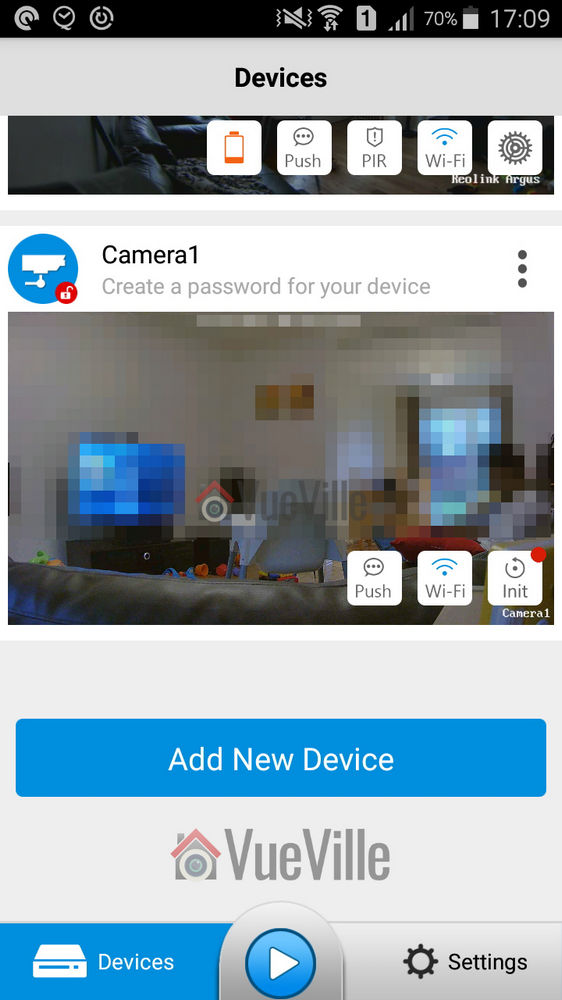
When I opened the mobile app, it had already added the Reolink C2 Pro automatically. There was a red indicator next to the ‘Init’ button for the C2 Pro. So I turned to the quick start booklet and sure enough it said the camera would be automatically detected.
Now its time to set up the Wi-Fi. I touched the Wi-Fi symbol for the C2 Pro, entered my Wi-Fi network details and then proceeded to perform the Wi-Fi test. The test was successful, so I backed out to the main devices page.
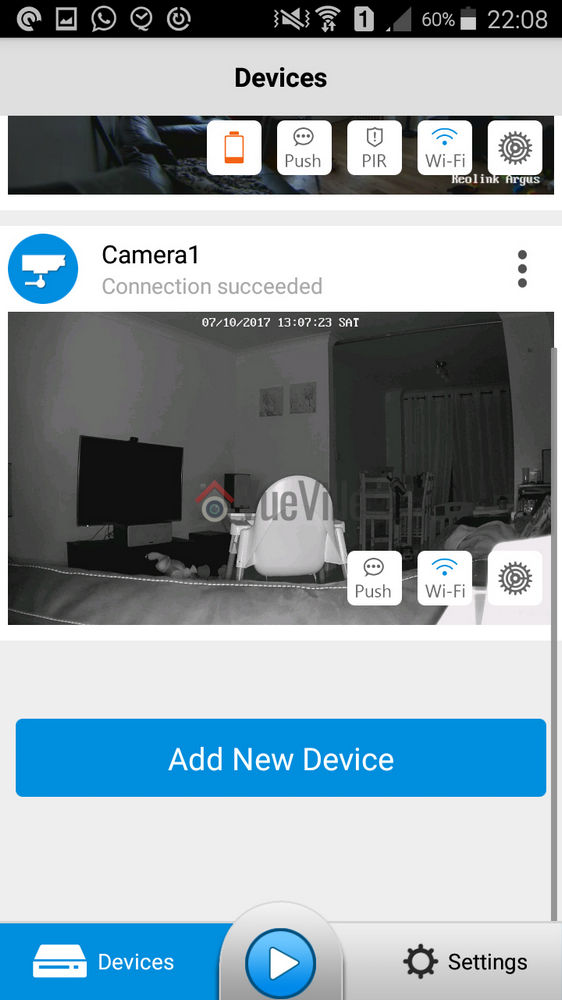
Next I clicked on the warning message saying ‘Create a password for your device’, and saved a password. The app then opened the camera’s dedicated page with all the control options including the PTZ button and Live View. Backing out to the main devices page showed that the warning message now changed to ‘Connection succeeded’.
Now the setup was complete and the Init button changed into a settings gear button.
Configuring the C2 Pro
The most convenient way of setting up the camera is using the Reolink mobile app. This is partly because you don’t need to know the camera’s IP address to access it. The mobile app does that for you.
The C2 Pro also has its own built-in web server where you can access the advanced settings. But to do this you need to know the IP address of the camera.
Since the initial setup requires the camera to be connected physically to your router via the Ethernet cable and DHCP is enabled by default to help newbies, the camera is accessible via that interface’s IP address. You can scan the network using any number of apps to find out the ethernet interface’s IP address.
If you have set up the Wi-Fi as well, that interface will have a separate IP address. Just like the Amcrest ProHD IP camera, both interfaces are live at the same time and you can choose to access the camera through either one. This is a very nice feature.
The Web Admin page
When you first log in to the web admin page, it takes you straight to the Live View page, which Reolink calls the ‘Preview’ page. Here you can control the PTZ function of the camera, switch between different resolution (clear/fluent/balanced), and access some of the OSD settings. You can also mute the camera audio if required. The C2 Pro’s web admin page still uses Adobe Flash just like the C1 Pro, I was really hoping for a more modern HTML5 interface.
The playback tab is for accessing the built-in NVR feature of the C2 Pro. What is the built-in NVR feature? Basically, pop in a microSD card and the camera can record continuous or motion detection triggered video clips or snapshots to the SD card. You can login any time from anywhere to review the footage through a timeline view.
This means that if you need only a single camera or two in your home , you don’t need to buy a separate NVR just to record video footage. The camera can also push notifications to the Reolink app on your mobile phone, send email alerts with attached snapshots or video clips and even upload them to an FTP server.
Moving on to the settings page, the various configuration options are neatly laid out in logical sections. You can set the video resolution and frame rates separately for the main stream (called clear stream) or the secondary stream (called the fluent stream). The secondary stream is used for the mobile app live view feature.
The network section lets you switch between static and dynamic IP allocation (DHCP), and also adjust many other settings such as the various ports used, set up a dynamic DNS ping, email notification setup, FTP settings, and push notifications. I was happy to see that uPNP is disabled by default – this is a great security feature. When ONVIF is available you really do not need uPNP.
Okay but how does the Reolink app manage to access the C2 Pro and receive push notifications even when you are outside your local network? Well its got to be that favourite protocol of every security camera manufacturer, P2P! Except, Reolink doesn’t call it that – you are looking for the UID setting. It is on by default which is fine for making the camera super easy to set up but for power users like me, I don’t need the C2 Pro to poke a hole through my network and connect to Reolink’s P2P servers. I have my super secure way of accessing my local network remotely through OpenVPN, so I immediately turned off the UID P2P feature.
Adding a microSD card for motion detection recording
I inserted a microSD card into the SD card slot. I had to push the card all the way into the slot before it click-locked. I then formatted the card through the web admin page. The camera then automatically rebooted and the microSD card was ready for use.
A word of warning here, by default the camera automatically will then start recording 24/7 to the SD card. I would have been happier to see the default set at ‘None’ or ‘Motion’ instead of ‘Normal’.
Mobile Push Notifications
Push notifications can be set up based on the time of the day. Remember that push notifications will not work outside your local network if you switch off P2P though.
Adding the Reolink to QNAP Surveillance Station
The C2 Pro supports ONVIF, so I was easily able to add it to my QNAP TS-253A’s Surveillance Station app. I first created an additional user for the NAS using the web admin page of the C2 Pro.
Performance
The C2 Pro is a 5 Megapixel camera that can do 25 frames per second, so its no surprise I found things ticking along nicely throughout the review with no slowdowns, frame stutters or any performance issue really.
Let’s look at the default settings the Reolink C2 Pro comes with from the factory:
Main stream: 5MP @ 25fps and 4Mbps
The default bitrate of 4Mbps is better than the C1 Pro’s default rate of 3Mbps.
Since these are the defaults, I ran my day and night tests at these settings.
In the System>Performance section of the web admin page, I could see that while idling the processor usage ranged between 30% and 35%. When motion was detected this went up to around 50%, so there was always sufficient headroom for the camera’s processor.
Video quality
Video captured was super crisp and detailed both during the day time and in total darkness, in line with my expectations for a 5 Megapixel IP camera.
Here are the motion detection triggered videos recorded at the default 5 Megapixel resolution, at 25 fps and 4 Mbps bitrate:
There was no blurring of the video and there were no dropped frames.
Motion detection
The C2 Pro is able to do both pre-recording and post-recording. This means the camera is able to record not just what happens after motion was triggered but 5 seconds before the trigger as well. This is a great feature and something that I always look for in a security camera.
The post-record feature lets you decide how many seconds the camera should record after the last motion trigger. The default is 15 seconds.
Night vision
The Infrared LEDs are reasonably powerful and can light up a decent sized room. There are no settings to control the brightness of the LEDs and there are no advanced features to dynamically control the infrared light output.
Audio quality
Just like most indoor security camera, the C2 Pro supports 2-way audio. Usually the implementation in most manufacturers’ native apps mutes the audio when you activate the microphone. In other words they have half-duplex audio, not full-duplex. Ideally to use the camera as an intercom, you need 2-way full duplex audio.
Interestingly Reolink has not claimed full duplex audio, however the Reolink app doesn’t mute the incoming audio when you press the microphone button. You can continue to hear what the person at the other end is saying when you are speaking. So the C2 Pro actually supports full duplex audio.
So how well does it work in practice? The audio quality is great and the dual speakers do a great job in reproducing audio. But there is a noticeable lag, however slight, in audio playback and this makes the full duplex capability less useful. We found ourselves using the Reolink C2 Pro more like a walkie-talkie just like the Amcrest ProHD.
PTZ performance
If you are planning to use the C2 Pro as a baby monitor with 2-way audio, you will be interested in how much noise it makes while panning and zooming.
Now the C1 Pro hardly makes a sound and so made a great baby monitor. Unfortunately the C2 Pro is a tad louder during the startup dance and for all PTZ motions. Not as loud as my Amcrest but definitely louder than the C2 Pro.
One other drawback I found is that the motion detection stays active even when you use the Pan-Tilt controls which means the camera records a motion detection clip each time you use the PTZ controls.
Wireless performance
I tested the camera over both Ethernet and Wi-Fi. But you know Ethernet is easy for any camera in 2019. What really matters is how good the Wi-Fi connection and performance is. The C2 Pro boasts of 2T2R MIMO antennae for improved wireless performance. So I moved the camera to the farthest point in my house to see how the Wi-Fi did. Over both 2.4GHz and 5 GHz, the C2 Pro was stable and performed just as if it was connected over Ethernet.
Mobile app live view
I first installed the Reolink Android app on my phone when I reviewed the RLC-423 PTZ. I then added the Reolink Argus, the Reolink C1 Pro and now the C2 Pro. I have been quite impressed with the fluid intelligent design of the mobile app, its definitely something that Hikvision for example can learn from. Where the iVMS app is clunky and often doesn’t work, the Reolink app simply delivers.
Live view on the app can be by camera or you can simultaneously view multiple Reolink cameras. There is a handy PTZ joystick button and the camera is quite responsive when you move the joystick around. Over a remote connection, there was a 0.5 second delay between moving the PTZ controls and the video changing.
Mobile app push notifications
So what should you be looking for when it comes to push notifications? The speed and reliability of the push notifications reaching you. You want the camera to send you push notifications immediately after it detects motion. Especially if you have configured email alerts, SD card recording at 5 Megapixel recording and push notifications, inferior cameras may struggle but not the C2 Pro.
Inside my local network I got push notifications on my phone instantaneously and on remote networks there was a delay of just 1 second which is very impressive. The success rate of receiving the push notifications over multiple motion triggers was a solid 100%.
Reviewing recorded footage
So this is how you access the built-in NVR feature of the C2 Pro. Clips recorded on the microSD card can be accessed either via the web admin interface or the Reolink mobile app.
Using the web browser interface
You can choose a date to review and if motion triggered recording is enabled, all these clips will be shown on the timeline. You can roll the mouse wheel to zoom in and out of the timeline to select specific clips. Click anywhere on the timeline and it will jump to the next recorded clip and then keep playing one clip after the other sequentially.
There is a handy download button which lets you download multiple clips to your computer. Overall great implementation and a very useful feature.
Using the mobile app
The Android mobile app also can access the built-in NVR feature of the C2 Pro. It works just like the web interface – you can choose the date to review and either let it play one motion triggered clip after the other or pick a specific point on the timeline.
Verdict
If you need the extra level of detail that 5 Megapixels provide, then the Reolink C2 Pro is the best affordable indoor PTZ you can buy today. But if super-quiet operation is more important, go for the C1 Pro instead.
The Amcrest ProHD is available with PoE whereas the Reolink doesn’t have PoE. It would be nice to have the option of choosing between PoE and Wi-Fi.
[review]
Where to buy
[easyazon_link identifier=”B07LH2RS77″ locale=”US” tag=”vueville.com-eaz-20″]Check Price on your local Amazon site[/easyazon_link]
(* = affiliate link / image source: Amazon Associates Program)